Reuters recently reported that soaring AI bills are reshaping how businesses choose models, as companies move from flat-rate experimentation into usage-based pricing tied to tokens, workloads, and model choices.
The easy headline is that companies are looking for cheaper AI.
But that is not the real lesson.
Cost is usually the first control problem leadership notices. The deeper issue is whether the company can see, route, govern, and move the AI work it now depends on.
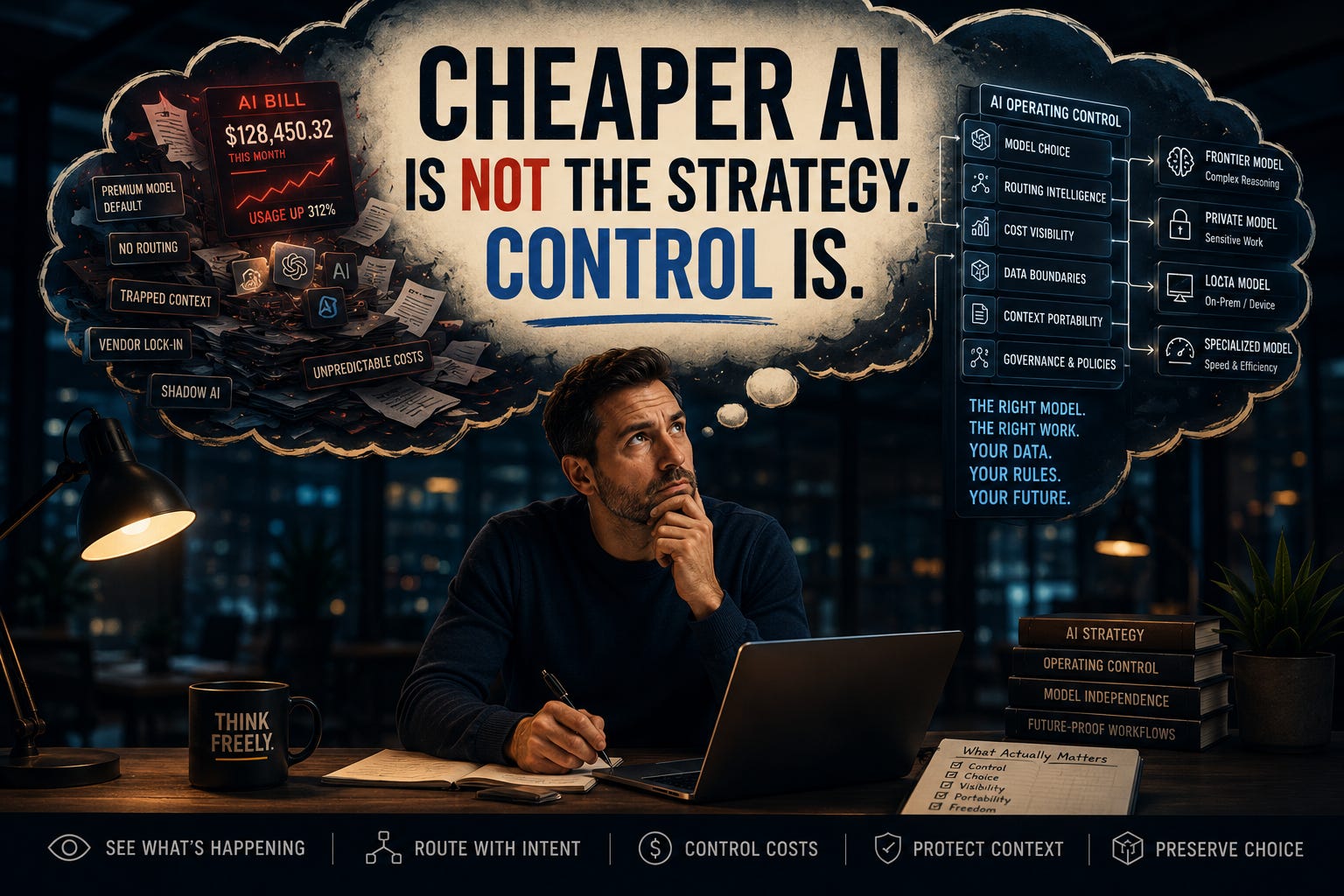
Cheaper AI is not the strategy.
Control is the strategy.
The problem was never the premium model
Premium models are useful. Sometimes they are the right choice.
Complex reasoning, sensitive judgment, strategic analysis, high-value writing, code review, technical interpretation, and executive decision support may justify a more capable model.
The mistake is not using premium models.
The mistake is defaulting to premium models for everything.
If every request goes to the most expensive model, that is not intelligence. That is unmanaged spending.
A support team may use AI to tag tickets, summarize long threads, draft first replies, search policy documents, and help resolve escalated customer issues.
Those are not the same job.
They should not automatically receive the same model, cost profile, privacy treatment, or review process.
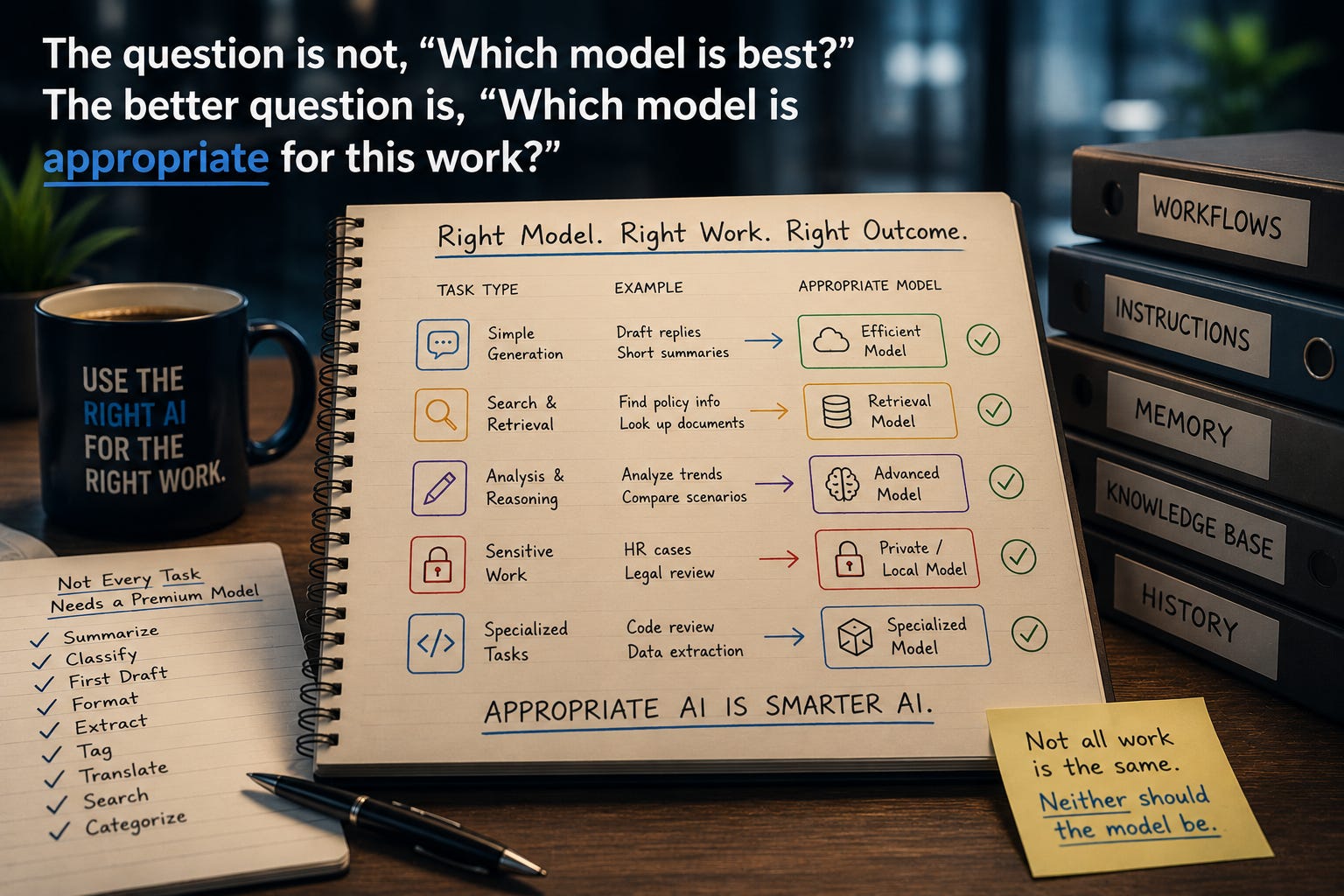
A short summary. A simple classification. A first-pass draft. A low-risk formatting task. A repeatable internal workflow. These may not need the same model as a complex strategy session or high-stakes analysis.
The question is not, “Which model is best?”
The better question is, “Which model is appropriate for this work?”
That is where AI independence stops being a philosophy and becomes an operating decision.
Cost is the first control problem leadership notices
AI cost shocks are useful because they make dependence visible.
When pricing is cheap, dependency feels convenient.
When pricing changes, dependency becomes strategy debt.
A company that hardwires its workflows into one model, one vendor, one interface, one memory layer, or one pricing structure may not notice the risk at first. The system works. People adopt it. Teams build around it. Habits form. Context accumulates. Instructions get refined. Workflows depend on vendor-specific features.
Then the market changes.
Prices shift.
Terms change.
Models rise and fall.
Features get bundled, restricted, or deprecated.
A new model becomes better for a specific task.
A privacy requirement changes.
A department wants a different tool.
Finance asks why every request is going to a premium model.
That is when the company discovers whether it built capability or dependency.
The market is moving toward model choice
The same Reuters report points to a broader shift away from one-model-for-everything usage and toward smaller, cheaper, specialized, open-source, and routed model strategies. It also notes rising interest in tools that help organizations assign tasks to different models based on cost and capability.
That matters because the next phase of AI will not be won by the companies that simply buy the most powerful model.
It will be won by the companies that know when to use it.
Some work should go to a frontier model.
Some work should go to a lower-cost model.
Some work should stay local.
Some work should go to a private environment.
Some work should never leave a controlled workflow.
Some work should not be automated at all.
That is not cheap AI.
That is appropriate AI.
And appropriate AI requires routing, policy, visibility, and governance.
The future is governed model choice
Another reason control matters is that the model market is still moving.
No serious company should assume today’s winning model will remain the best choice for every task, every department, every workflow, and every budget forever.
Microsoft CEO Satya Nadella has also argued for companies to build AI capability around their own data, workflows, and learning systems rather than treating a small set of foundation models as the whole strategy. Business Insider summarized that view here: Satya Nadella said every company should build its own AI model.
That is a major signal.
When even the largest platform companies are talking about company-specific AI capability and multi-model strategy, the lesson should be clear.
The future is not one default model.
The future is governed model choice.
But model choice only matters if your workflows, context, rules, memory, and business logic are not trapped in one vendor-controlled path.
Cost is only one side of dependence
Rising AI bills make the cost problem obvious.
But cost is not the only thing that gets trapped.
Once AI becomes part of daily work, the deeper question becomes what else is inside the platform.
Conversations.
Memory.
Instructions.
Workflow behavior.
Assistant preferences.
Retrieval patterns.
Project history.
Business context.
That is why the AI lock-in conversation cannot stop at price.
A company may be able to switch to a cheaper model for some tasks. But if the useful context is trapped somewhere else, switching is still expensive.
Not always in dollars.
Sometimes in lost continuity.
Sometimes in lost memory.
Sometimes in rebuilt workflows.
Sometimes in retrained users.
Sometimes in the quiet frustration of realizing that the “AI system” was never really yours to move.

Have you noticed how hard context is to move?
Most people understand data lock-in.
They know to ask whether files can be exported. They know to ask whether records can be migrated. They know to ask whether a database can be backed up.
But AI creates a new kind of lock-in.
Context lock-in.
Your content may still belong to you. Your documents may still be exportable. Your files may still sit in your cloud storage.
But what about the AI-ready context that forms around that content?
Can you export the conversations?
Can you export the memory?
Can you export the instructions?
Can you export the retrieval behavior?
Can you export the workflow history?
Can you export the assistant preferences?
Can another model actually use that exported context in a meaningful way?
OpenAI provides a way for users to export ChatGPT data, including chat history and account data. OpenAI’s help article explains the export flow here: Exporting your ChatGPT history and data.
That export option is useful.
But a data export is not the same thing as portable operating context.
A zip file is not a strategy.
You may be able to download the record of what happened. That does not mean you can recreate the working relationship.
The deeper question is whether the context can move in a way that preserves business usefulness.
That is the next lock-in conversation.
Platform memory is not business memory
AI memory is convenient. It can make the experience feel personal, continuous, and more productive.
But platform memory is not the same as business memory.
Platform memory lives inside someone else’s product assumptions. It is shaped by that platform’s interface, rules, export structure, retention policy, pricing model, and roadmap.
Business memory should be different.
Business memory should be governed.
It should be structured around the organization’s workflows, policies, knowledge, preferences, roles, permissions, data boundaries, and operating rules.
It should not become trapped inside one vendor’s default assistant experience.
This is why context portability matters.
Not because every piece of context can move perfectly today.
Not because every workflow can switch models without adjustment.
Not because vendors are bad.
The issue is simpler than that.
If AI becomes part of how your business thinks, drafts, decides, retrieves, routes, and remembers, then the context layer becomes strategic infrastructure.
You should know who controls it.
AI independence is not anti-vendor
This point matters.
AI independence does not mean avoiding OpenAI, Anthropic, Google, Microsoft, Meta, Mistral, xAI, or any other provider.
It does not mean frontier models are bad.
It does not mean local models solve everything.
It does not mean open source always wins.
AI independence is not anti-vendor.
It is anti-dependence.
Use the best tool when it fits the work. Use the premium model when the task deserves it. Use a private model when the data requires it. Use a local model when the workload and hardware make sense. Use a specialized model when it performs better for a narrow job.
But do not confuse access with control.
Do not confuse convenience with architecture.
Do not confuse a vendor’s default workflow with your company’s AI operating model.
Cheaper AI without governance becomes cheaper chaos
There is another trap here.
Some companies will react to cost pressure by simply chasing cheaper models.
That is not enough.
A cheaper model can still be the wrong model.
A cheaper workflow can still expose the wrong data.
A cheaper answer can still create operational risk.
A cheaper tool can still increase lock-in.
A cheaper system can still fragment context across teams.
Cost control is not about always spending less.
It is about matching model spend to task value.
That requires classification.
What is the task?
How sensitive is the data?
How much reasoning does it require?
What quality threshold matters?
Is the output internal or external?
Does a human need to review it?
Does the workflow need auditability?
Can this run locally?
Should this go to a private model?
Is a premium model justified?
Until those questions are answered, model choice is just guesswork.
What gets controlled before AI scales?
The companies rushing into AI are not wrong to move quickly.
Waiting too long has its own cost.
But speed without control creates a predictable pattern.
First, teams experiment.
Then usage spreads.
Then workflows depend on tools.
Then costs rise.
Then sensitive data questions appear.
Then leadership asks for visibility.
Then finance asks for accountability.
Then IT asks who approved what.
Then compliance asks where the data went.
Then operations asks why every team is doing something different.
That is the moment when AI adoption stops being a technology question and becomes an operating control question.
Who decides which model is used?
Who decides what data can go where?
Who sees usage by team, workflow, and cost?
Who knows which tasks justify premium reasoning?
Who owns the context layer?
Who can move workflows if pricing, models, or vendor policies change?
Who can say no to a use case that should not be automated yet?
AI pilots can be messy.
AI operations cannot.
Build where you can move
The AI market is still young.
Prices will change.
Models will change.
Context windows will change.
Memory systems will change.
Enterprise policies will change.
Governance questions will get harder as AI becomes embedded in more workflows.
Vendors will bundle features.
Vendors will remove features.
Vendors will compete aggressively.
Vendors will protect their ecosystems.
That is normal. That is how markets work.
The answer is not to avoid vendors.
The answer is to avoid building your entire AI operating model inside someone else’s defaults.
Own your content.
Control your context.
Route work based on cost, privacy, capability, and policy.
Keep sensitive work where it belongs.
Reserve premium models for work that justifies the cost.
Preserve the ability to change direction when the market changes.
A cheaper model may lower the bill.
A controlled AI operating model changes the risk.
The lesson from rising AI bills is not that the cheapest model wins.
The lesson is that uncontrolled AI gets expensive, fragile, and hard to move.
Build where you can move.
Think Freely.