


I have been wrestling for months with a simple but uncomfortable idea: the AI model war is distracting companies from the deeper lock-in problem.
Nate B. Jones put useful language around that issue in his recent video on GLM 5.2 and the last-mile AI harness problem.
The AI conversation is still spending too much energy on which model is best.
Is it OpenAI? Claude? Gemini? DeepSeek? GLM? Open source? Local? Frontier?
Those questions matter, but they are not the deepest questions anymore.
I think the deeper question is this:
Who controls the work system around the model?
That is where the more durable lock-in is likely to form.
A company does not become dependent on an AI provider just because it uses that provider’s model. Dependency happens when the company’s workflows, context, memory, tools, data, permissions, habits, and team processes all become wrapped around that provider.
At that point, switching models is no longer a simple cost decision. It becomes an operational problem.
That is why real model independence is not just the ability to call a different API.
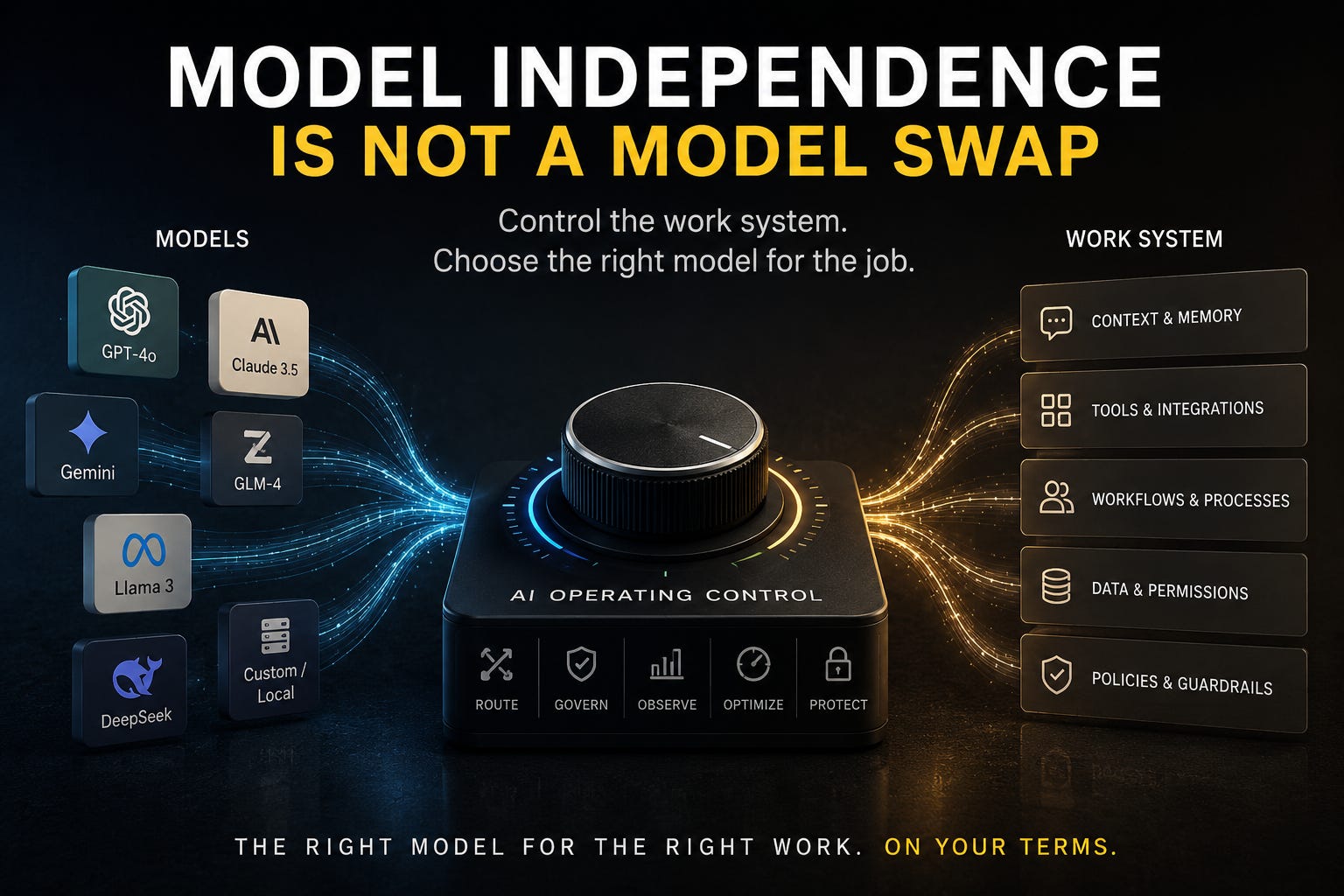
Model independence is the ability to use, route, replace, govern, and optimize AI models without rebuilding the business workflows that depend on them.
I have spent my career around digital systems, marketing operations, business workflows, and now AI implementation. The more I look at where enterprise AI is going, the more convinced I am that the next major risk is not whether companies can access intelligence. They can. The risk is whether they can keep control of the systems, context, and workflows that intelligence plugs into.
Cheap intelligence changes the math
Nate’s video centered on GLM 5.2, an open model he described as genuinely impressive, especially for what he called “center of distribution” work.
That phrase is useful.
A meaningful share of business work has familiar shapes: first drafts, summaries, routine coding tasks, standard PowerPoint outlines, website copy, structured emails, knowledge synthesis, internal documentation, repetitive analysis, support responses, content repurposing, and process explanations.
For that kind of work, cheaper models are getting very good.
Not merely “good enough.” In some cases, genuinely excellent.
That changes the economics of AI adoption. If a business is sending every AI request to the most expensive model by default, it may be overspending dramatically.
A premium model may be the right choice for complex reasoning, high-stakes work, sensitive judgment, or tasks where quality failures are expensive. But it should not automatically become the default path for every low-risk, repeatable, inspectable task.
Cost control does not mean using the cheapest model. It means using the appropriate model.
That requires a company to understand the work being done. Companies need to know which tasks are simple, which are complex, which are sensitive, which require frontier-level reasoning, which can move to lower-cost or private models, and which should never leave a controlled environment.
This is where the AI conversation moves from model selection to operating control.
The model is not the work system
One of the most important points Nate made is that companies are not simply replacing a model call. They are replacing a work system.
That is the part too many people miss.
A model by itself is not an AI operating capability. It is an intelligence engine. It still needs the surrounding system that makes it useful inside a real organization.
That surrounding system includes prompts, memory, company context, tool access, permissions, data boundaries, review workflows, cost monitoring, routing rules, and the way teams actually use the system.
This is why a company cannot simply say, “Claude is expensive, so let’s switch to GLM,” or “OpenAI is expensive, so let’s use DeepSeek,” and assume the problem is solved.
The model may be replaceable, but the work system may not be.
If the prompts, workflows, tools, memory, integrations, and team habits were all built around one provider, then the company is not model independent. It is model dependent, even if another model is technically available.
That is the difference between model access and model independence.
The real lock-in is context
The most serious lock-in risk is not the model itself. It is context.
Imagine a company lets an AI assistant sit inside Slack for six months.
It learns the shorthand. It sees the recurring debates. It watches customer issues come up again and again. It starts to understand project history, internal priorities, who owns what, how decisions get made, what problems keep returning, and what the company actually means when people use messy internal language.
Now the CFO asks a reasonable question: why are we sending so much routine work through a premium model?
Technically, the company can use a cheaper model. Operationally, the team does not want to move.
The current assistant already understands the company. It is already in the flow of work. People already know how to use it. The context is already there.
That is lock-in, but not API lock-in. It is context lock-in.
This is why “renting your company brain back from the provider” is such a useful phrase.
If your company’s working context lives inside a vendor-controlled AI workflow, then over time you may end up paying to access intelligence that is only useful because it sits so close to your own business activity.
Even if the provider has good privacy policies. Even if the provider behaves ethically. Even if your data is not used to train public models.
You may still be giving a single vendor too much operational gravity inside your company.
Frontier AI providers are going to build increasingly convenient experiences. They should. That is their job.
They will embed into Slack, email, documents, code editors, browsers, customer support tools, CRMs, and operating systems. They will make AI feel natural, easy, and indispensable.
Many of these products will be genuinely useful. That is what makes the strategic question harder.
Bad products are easy to reject. Useful products are where dependence forms.
A company can wake up one day and realize that a single AI provider is not just answering prompts. It is sitting inside team communication, project workflows, customer data, internal documents, code, and management processes.
At that point, the question is not, “Can we technically use another model?”
The question is, “Can we actually move the work?”
That is not a reason to reject frontier AI. It is a reason to build with independence in mind.
Open source alone does not solve this
Some people hear this argument and turn it into a simple open-source versus closed-source debate.
I think that misses the point.
Open models are part of the answer, but they are not the entire answer.
A company can use open models badly. A company can still create brittle workflows, poor governance, weak privacy controls, and operational complexity around open AI.
A company can also use frontier models responsibly if it has the right routing, governance, cost visibility, and data boundary controls in place.
The issue is not whether a model is open or closed.
The issue is whether the business controls the operating layer.
The real question is whether the company can choose the right model for the task, route sensitive work differently from low-risk work, reserve premium models for work that justifies the cost, change providers without rebuilding the workflow, keep memory and business logic portable, see what AI is being used, and govern usage before AI becomes shadow IT.
That is AI independence.
Not avoiding vendors. Not worshiping open source. Not pretending local AI solves every problem.
AI independence means preserving choice.
The next phase is control
The first phase of AI adoption was about access.
Companies wanted access to ChatGPT, Claude, Gemini, copilots, agents, and automation tools. That was the natural first stage. People needed to experiment. Teams needed to learn. Leaders needed to see what was possible.
The next phase is about control.
As AI spreads across companies, leaders need to know what AI is being used, where the work is going, what it costs, what data is exposed, which models are approved, which tasks require human review, and which workflows are becoming dependent on a vendor.
That operating structure is what I think more companies are going to need.
Call it AI Operating Control. The name matters less than the discipline.
Companies need a way to govern, route, monitor, optimize, and adapt AI usage across models, vendors, workflows, users, data boundaries, and cost structures.
Without that control, AI adoption becomes scattered.
One team uses one tool. Another team uses another. Developers use one model. Marketing uses another. Customer service experiments with a chatbot. Finance has no clear view of cost. Legal has no clear view of exposure. Leadership has no clear view of what is happening.
That may work during experimentation. It will not work at scale.
AI pilots can be messy. AI operations cannot.
This is also why businesses need task awareness, not model loyalty.
Some tasks are simple, repeatable, and easy to inspect. They may be perfect for lower-cost models.
Some tasks involve sensitive internal data. They may require local or private handling.
Some tasks require deep reasoning, careful judgment, or high creative quality. They may justify a premium frontier model.
Some tasks are not appropriate for AI at all, at least not without human supervision.
This has direct financial and operational consequences. If every task routes to the most expensive model, the company wastes money. If sensitive tasks route to the wrong environment, the company creates data risk. If complex tasks route to weak models, the company creates quality risk. If workflows are hardwired to one provider, the company creates lock-in risk. If nobody can see usage, the company creates management risk.
Independence is how companies manage those tradeoffs deliberately instead of letting vendor defaults decide for them.
Why I am writing about this
I am not writing about this as a detached observer.
This is the problem space we have been building into.
At Buildtelligence, we have been building the early foundation of an AI operating layer around this exact problem: model independence, routing, governance, cost control, privacy boundaries, and workflow portability.
What started as a last-mile model router has become something broader: a way to help companies keep the work system separate from the model provider underneath it.
It is still early. It is not a finished answer to every problem I have described here.
But the direction is clear.
Companies are going to need a way to use frontier models, open models, local models, and private AI environments without letting any one provider become the default owner of their context, workflow, or cost structure.
That is the operating category I believe is forming.
And it is the category we are building into.
The question every company should ask
Before adopting another AI tool, leaders should ask a few direct questions.
Are we choosing this model because it is right for the work, or because it is the default?
Do we know which tasks actually require premium models?
Do we know which tasks could route to lower-cost models?
Do we know where sensitive data is going?
Do we know which workflows are becoming vendor-dependent?
Do we own our company context, or are we renting it back through a provider-controlled interface?
Can we switch models without rebuilding the workflow?
Can leadership see usage, cost, risk, and value?
If the answer to those questions is unclear, the company does not have AI Operating Control yet.
It may have AI access. It may have AI enthusiasm. It may have AI tools. But it does not yet have a controlled AI operating model.
Cheap intelligence is here. That is good news.
But cheap intelligence alone does not create AI independence.
The companies that benefit most from this new era will be the ones that build the last mile: the routing, governance, context, privacy, workflow, and cost-control layer that lets them use the right AI for the right work.
The goal is not to avoid frontier models. The goal is not to blindly chase the cheapest model. The goal is to preserve control.
Use premium models where they matter. Use lower-cost models where they are sufficient. Keep sensitive work where it belongs. Build workflows that can adapt as the market changes.
Do not rent your company brain by accident.
That is the conversation I plan to keep writing about here: how companies adopt AI without surrendering control of cost, data, context, workflows, or strategic choice.
Access was phase one. Control is phase two.