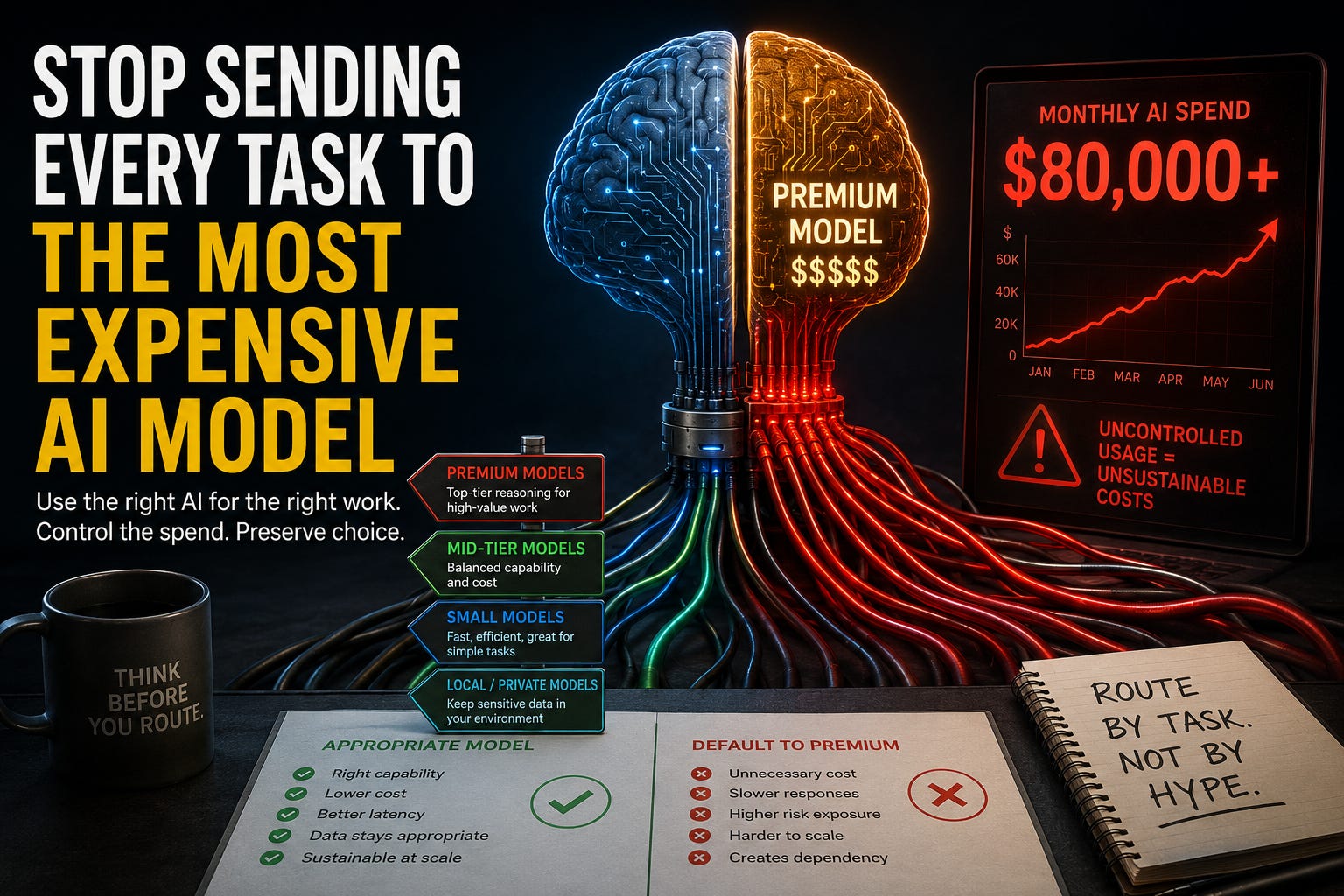
A fintech employee reportedly burned through $80,000 in AI coding tokens building a simple “brainrot shooter” game.
Axios reported that corporate America is facing AI sticker shock, with Microsoft scaling back Claude Code licenses over cost concerns and Uber executives saying rising AI expenses are becoming harder to justify.
Goldman Sachs Research expects agentic AI to drive a 24-fold increase in token consumption by 2030.
And a research paper on agentic coding found that these workflows can consume 1,000 times more tokens than ordinary code chat or code reasoning, with runs on the same task varying by up to 30 times in total token use.
There is another point business leaders should not miss.
These cost blowups are happening during the cheap-access phase of AI.
The market is still fighting for users, developers, enterprise accounts, workflow capture, and default status. If companies can burn through shocking amounts of AI spend while access is still aggressive and adoption-driven, what happens when usage grows, agentic workflows become normal, “unlimited” plans tighten, and premium reasoning gets metered more aggressively?
I wrote about the larger model-dependence playbook in We Have Seen This Playbook Before: cheap access first, workflow dependence second, monetization pressure later.
AI cost control cannot wait until the bill hurts.
By then, the workflow may already be dependent.
AI cost control is becoming one of the central operating problems of enterprise AI adoption.
The lesson is not that companies should stop using AI.
The lesson is that AI cost control cannot depend on vibes, individual restraint, or the assumption that every task belongs on the strongest model.
The fastest way to overspend on AI is to treat every task like it deserves the most expensive brain.
That sounds obvious.
But it is exactly how many companies are adopting AI right now.
They pick a powerful model. They give teams access. They connect a few workflows. They start experimenting. The results look impressive. The team gets excited. The model becomes the default.
Then the default becomes the strategy.
That is where the problem starts.
Not because frontier models are bad.
They are not.
The problem is simpler: not every task deserves premium reasoning, premium cost, premium latency, premium context, or premium data exposure.
Some work needs the best model available.
Some work does not.
The difference matters.
Premium models are not the problem
The wrong version of this argument is easy to make.
I am not arguing that companies should avoid expensive models, that cheaper models are always better, that local AI replaces everything, or that open source solves every cost problem.
The point is simpler: model choice should be intentional.
A premium model may be the right choice for complex reasoning, advanced coding, sensitive strategic analysis, high-value decision support, legal review, technical planning, or work where quality has material business consequences.
But if every request goes to the most expensive model by default, the company is not making an intelligent decision.
It is accepting a habit.
And habits get expensive when they scale.
AI pilots hide waste
AI pilots are forgiving.
A small team uses a powerful model. The cost is manageable. The output is impressive. Nobody worries too much about whether a simpler model could have done the same work for less money.
That is fine during experimentation. The purpose of a pilot is learning.
But AI operations are different.
Once AI moves into daily workflows, usage grows. More people get access. More tasks get routed through the system. More prompts become recurring. More automations run in the background. More agents call more tools. More context gets passed. More teams expect AI to be available all the time.
At that point, small inefficiencies become operating costs.
The waste that looked harmless during experimentation becomes a budget line.
AI pilots can tolerate inefficient usage.
AI operations cannot.
The hidden cost is the default path
Most AI overspending will not begin with a CFO approving a reckless contract.
It will begin with a default.
The default model. The default assistant. The default workflow. The default integration. The default API endpoint. The default assumption that stronger is always safer.
That assumption is dangerous.
Stronger is not always better.
Better means appropriate for the task.
If a team is summarizing public web content, does it need the most advanced reasoning model?
If a workflow is extracting structured information from a standard form, does it need premium creative intelligence?
If an internal assistant is classifying low-risk tickets, does every request need to route to the same model used for executive strategy?
If a simple transformation task can be handled reliably by a smaller or cheaper model, why force it through the most expensive path?
The answer is usually not strategy.
It is convenience.
Convenience is how AI budgets break.
Agents make the problem worse
The cost problem becomes more serious when AI moves from chat to agents.
A chat request is usually bounded. A user asks. The model responds. The interaction may be expensive, but it has a visible shape.
Agents are different.
Agents can plan, read files, call tools, write code, inspect errors, retry, revise, search, test, summarize, and continue working through loops the user may not fully see.
That is useful.
It is also expensive when unmanaged.
The cost problem is not only that models are expensive.
It is that agents can keep working, retrying, reading, rewriting, and calling tools long after a human would have stopped.
That is why a toy coding project can turn into an $80,000 token story.
That is why agentic coding costs can vary wildly from one run to another.
That is why falling token prices do not automatically mean falling AI bills.
If usage grows faster than unit costs fall, the invoice still goes up.
Token discipline will not emerge by accident
Gartner’s warning about AI coding costs potentially surpassing developer salaries should get every leadership team’s attention.
Not because the prediction is guaranteed.
Because the direction is clear.
When AI tools become part of the daily workflow, cost control cannot depend on each developer, marketer, analyst, operator, or manager voluntarily optimizing token spend in real time.
Users want the work done. Developers want the code shipped. Marketers want the campaign drafted. Analysts want the answer. Support teams want the ticket resolved.
The people doing the work are not naturally thinking like model economists.
They should not have to.
Token discipline will not emerge because every employee suddenly becomes a budget officer.
It has to be designed into the operating model.
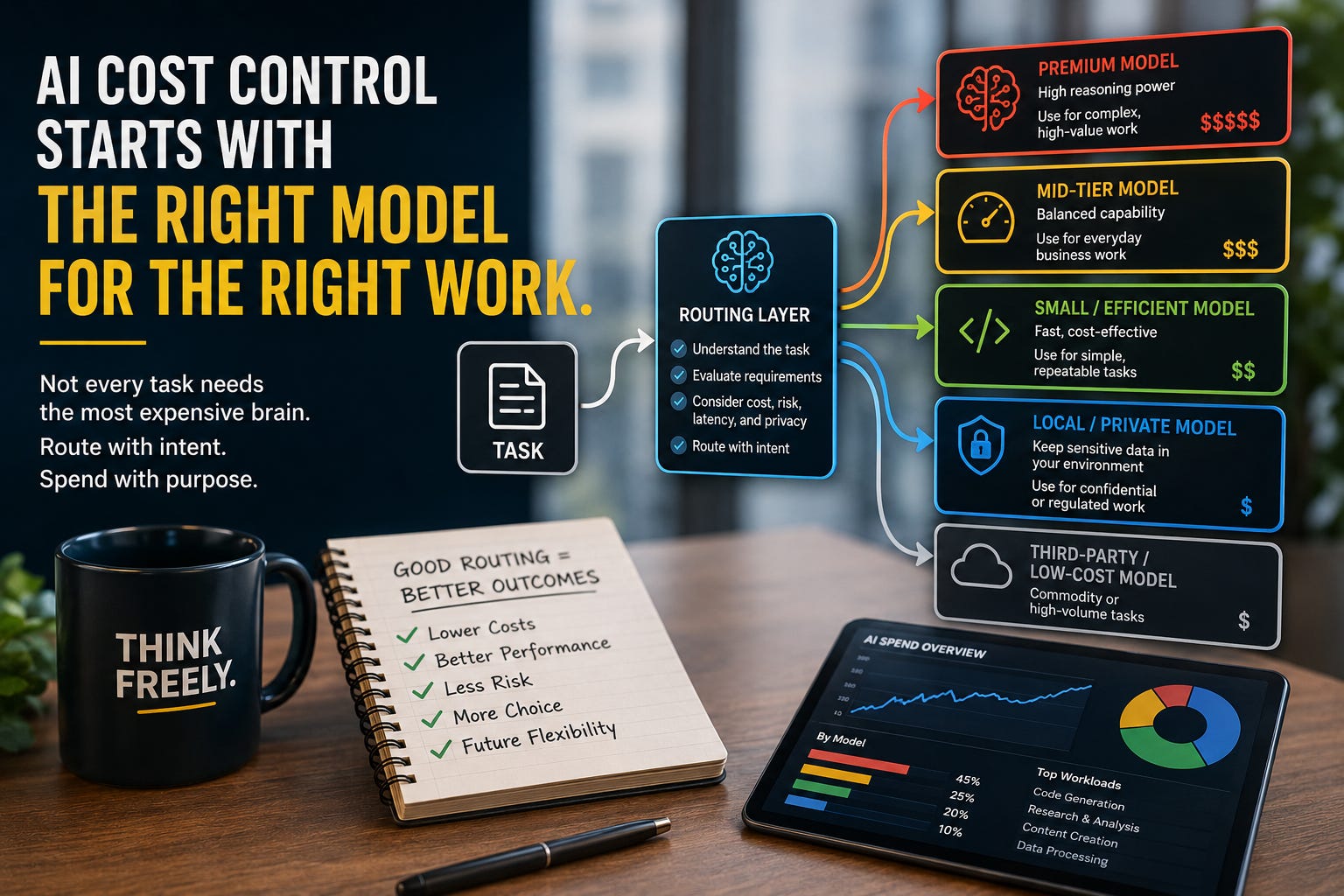
AI cost control means creating visibility into AI usage, classifying workloads by value and risk, and routing each task to the model or environment that fits its capability, cost, privacy, and governance requirements.
The question is not “What is the best model?”
The AI market loves the best-model debate.
Which model is smarter? Which model wins the benchmark? Which model codes better? Which model reasons longer? Which model has the biggest context window?
Those questions matter.
But they are not the right starting point for business operations.
The better question is: what does this work require?
Does it need deep reasoning, factual precision, speed, low cost at scale, a large context window, sensitive-data handling, tool use, consistency, multimodal input, human review, or premium model spend?
The task should determine the model.
Not the hype cycle.
Not the vendor default.
Not the model leaderboard.
Not the most impressive demo.
The work should decide.
AI cost control starts with workload classification
A company cannot control AI cost intelligently until it understands the work being done.
That means classifying workloads before routing them.
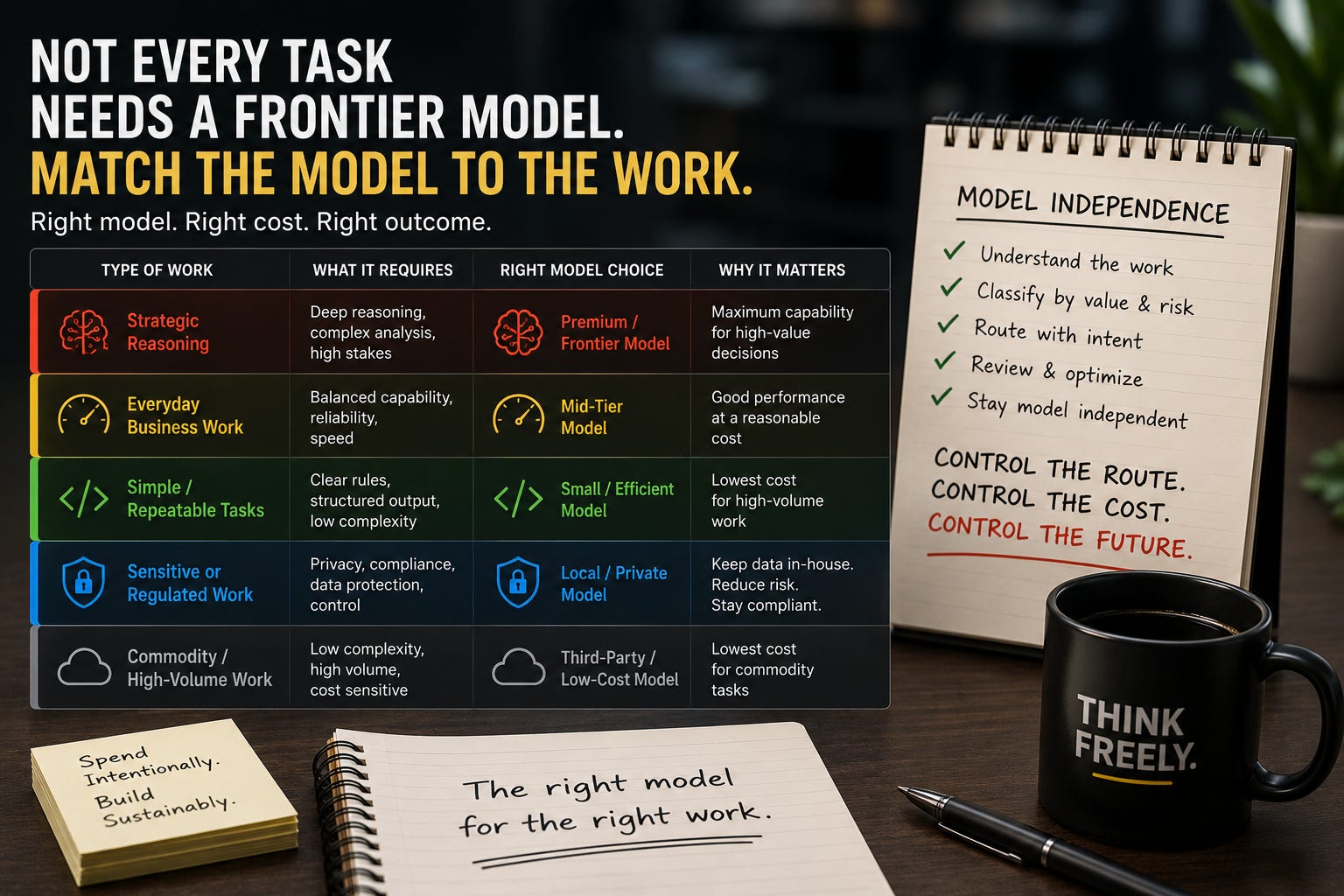
Some workloads are low-risk and repetitive. Others are high-volume and cost-sensitive. Some involve sensitive data and should stay inside approved environments. Some require frontier-level reasoning, speed, structured output, consistency, or human review.
Without classification, every task starts to look the same.
And when every task looks the same, companies tend to default to the strongest model because it feels safer.
But that is not governance.
That is overcorrection.
A mature AI operating model should ask: What kind of work is this? What level of capability does it require? What data is involved? What cost is acceptable? What model or environment is approved? What happens if the first choice is unavailable? What level of quality and oversight is needed?
That is how AI cost control begins.
Not with a cheaper model.
With a better decision.
Cheap is not the goal
Cost control can easily sound like a race to the bottom.
That is not what I am arguing for.
The goal is not cheap AI.
The goal is appropriate AI.
There is a difference.
Cheap AI asks, “How do we spend less?”
Appropriate AI asks, “What level of capability does this work justify?”
Cheap AI can create quality problems, rework, risk, frustration, and hidden labor costs.
Appropriate AI protects quality while avoiding unnecessary premium usage.
For some tasks, the appropriate model may be the most powerful model available. For other tasks, it may be a smaller model, a private or local environment, a specialized model, a low-cost third-party model, or a premium model with human review.
The point is not to minimize spend at all costs.
The point is to match model spend to task value.
That is the discipline.
Premium work deserves premium models
There are times when using the best model is exactly the right decision.
If a task affects strategic decisions, high-value sales opportunities, legal exposure, customer trust, engineering quality, security posture, or executive judgment, then model quality matters.
In those cases, paying more may be the responsible choice.
But that is precisely why premium models should not be wasted on work that does not need them.
Premium capacity should be reserved for premium work.
That is not cheap thinking.
That is operating discipline.
A business does not use its most expensive expert for every administrative task. It does not send every document to outside counsel. It does not put every support ticket in front of the CEO. It does not assign senior engineers to every routine configuration change.
The same logic applies to AI.
Use the strongest capability where the strongest capability matters.
Use something else where it does not.
Defaulting to one model creates dependency too
Cost is not the only issue.
When every task routes to one premium model, the company also creates dependency.
The prompts are tuned to that model. The workflows assume that model’s behavior. The team expectations are shaped by that model’s outputs. The quality review process adapts to that model’s strengths and weaknesses. The operating model quietly becomes dependent on one provider’s cost structure, latency, limits, safety policies, roadmap, and availability.
That means overspending and lock-in are often connected.
The company is not just paying too much.
It is becoming less flexible.
This is why model independence matters.
A model-independent company is not forced to choose between quality and cost. It can route based on the work.
Some tasks go to frontier models. Some go to private models. Some go to local models. Some go to specialized models. Some go to lower-cost approved models. Some require human review. Some should not be automated.
That flexibility is where cost control becomes strategic.
Routing is how cost discipline becomes operational
It is easy to say, “Use the right model for the right work.”
The harder question is how.
The answer is routing.
Routing is the mechanism that turns AI cost control from a policy statement into an operating system.
A routed AI environment can evaluate work based on capability, cost, data sensitivity, privacy requirements, latency, context needs, approved vendors, and business value.
It can send a simple task to a lower-cost approved model. It can reserve a premium model for high-value reasoning. It can keep sensitive work in a private or local environment. It can direct specialized tasks to specialized models. It can require human review for certain categories. It can fall back when a model is unavailable. It can give leadership visibility into which teams, workflows, and tasks are driving AI spend.
Without routing, cost control depends on user judgment, manual discipline, or after-the-fact reporting.
That is not enough.
Users should not have to become model economists before sending a prompt.
The system should help route the work.
Visibility comes before control
A company cannot control what it cannot see.
Before leadership can manage AI cost, it needs to know which teams are using AI, which workflows are using which models, which tasks are driving spend, which requests are going to premium models, and which workloads could be routed differently.
Without that visibility, AI cost becomes a surprise.
And surprise is not a strategy.
Visibility does not mean blocking usage.
It means knowing what is happening.
Once leadership can see usage by model, workflow, team, cost, and business value, then it can make better decisions.
That is how cost control becomes governance.
The real risk is not that AI is expensive
AI may be expensive.
But that is not the real risk.
The real risk is that AI becomes expensive without the company knowing why.
The deeper risk is that this happens while companies are still being trained on early-market access economics.
If today’s relatively cheap AI access is already producing $80,000 token stories, license pullbacks, executive budget concerns, and warnings about agentic token growth, then the answer cannot be, “We will figure out cost discipline later.”
Later is when the workflows are harder to unwind. Later is when teams have already adapted. Later is when the premium model has become the default assumption. Later is when the vendor, model, interface, and cost structure have quietly become part of the operating model.
Expensive may be acceptable if the work is valuable.
Expensive may be justified if the model is delivering quality, speed, leverage, or business advantage.
Expensive may be strategic if it supports high-value outcomes.
But expensive without visibility is dangerous.
Expensive without routing is wasteful.
Expensive without governance is fragile.
Expensive without task-value alignment is not strategy.
It is drift.
The future is cost-aware AI
The next phase of AI adoption will not be about giving everyone access to the strongest model and hoping the bill makes sense.
That is not sustainable operating design.
The next phase will be cost-aware, privacy-aware, capability-aware, and workflow-aware.
Companies will need to know what work is being done, which model is appropriate, what cost is justified, what data can move, what policy applies, and what fallback exists.
That is not a technical footnote.
It is the foundation of AI Operating Control.
AI Operating Control means the business can see, route, govern, optimize, and adapt AI usage across real workflows.
It gives leadership visibility into AI spend. It gives teams access to the right capabilities. It gives finance a way to understand cost drivers. It gives IT and operations a way to govern usage. It gives the business a way to use AI without surrendering control to one default path.
The point
The point is not to use the cheapest model.
The point is to stop using the most expensive model by habit.
The point is not to reduce AI quality.
The point is to align quality, cost, sensitivity, and business value.
The point is not to avoid frontier models.
The point is to reserve them for work that justifies frontier capability.
A company that sends every task to the most expensive brain is not being safe.
It is being unmanaged.
The question is not, “What is the best model?”
The question is, “What is the right model for this work?”
That is AI cost control.
That is model independence.
Use the right AI for the right work.
Preserve choice.
Control the spend.
Think freely.