


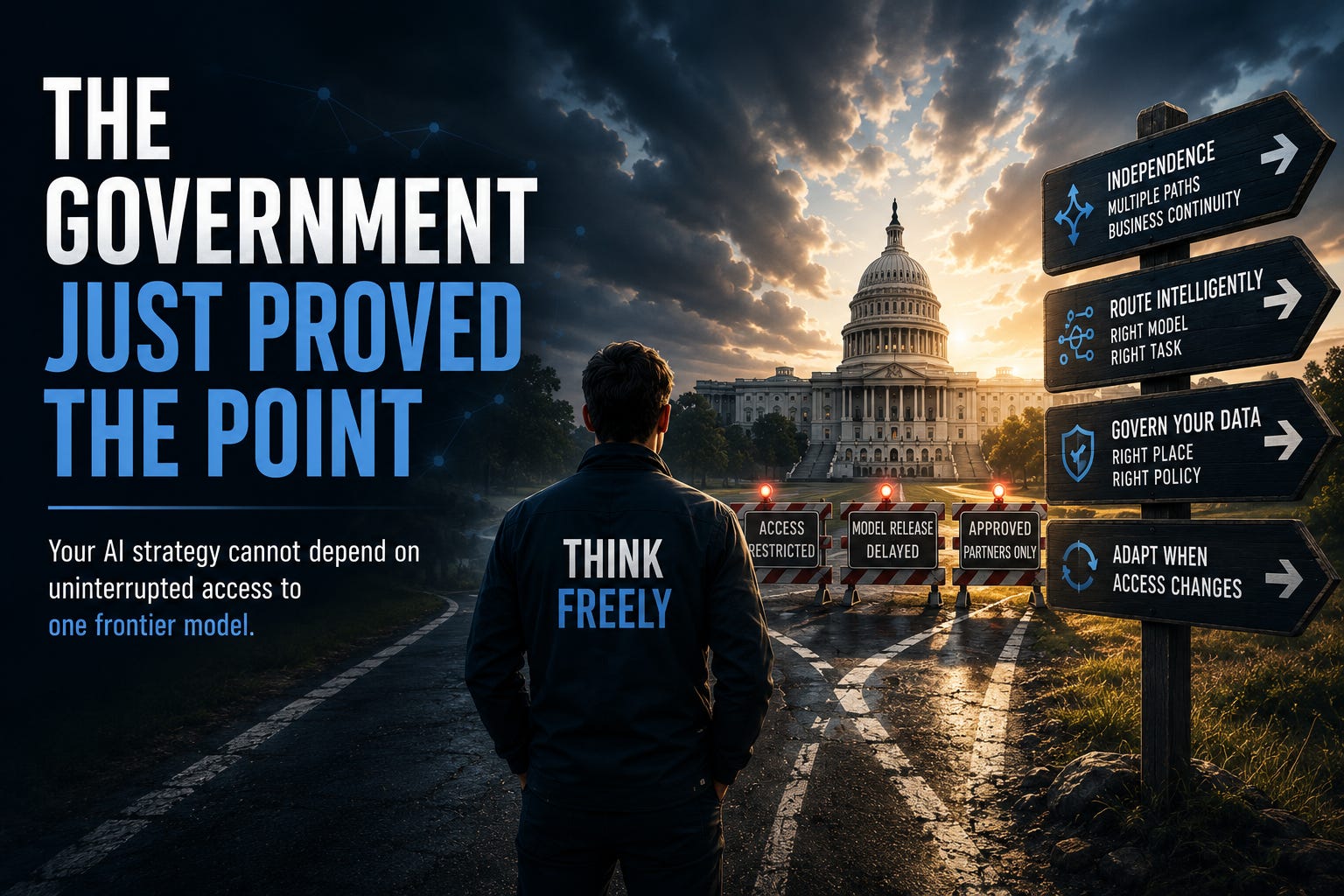
The model does not have to fail for your workflow to break.
The vendor does not have to go out of business. The API does not have to degrade. The pricing does not even have to change.
A model can be delayed, restricted, reviewed, export-controlled, disabled, or made available only to approved customers because someone outside your company decides the risk profile has changed.
That is not theoretical anymore.
Reuters reported that OpenAI delayed the full public rollout of GPT-5.6 at the request of the U.S. government. Axios reported that the Trump administration asked OpenAI to limit the model’s release to a small set of government-approved partners.
Separately, Reuters reported that a legal technology company sued the U.S. government over a directive restricting foreign-national access to Anthropic’s advanced models, Fable 5 and Mythos 5. Reuters later reported that Anthropic’s Mythos 5 access was restored to more than 100 trusted U.S. organizations after a prior suspension over national-security concerns.
Set aside, for a moment, whether those government actions were right or wrong.
That is not my point.
My point is simpler: frontier model access is now conditional.
And if access is conditional, dependence is dangerous.
The more serious scenario
The OpenAI story is about a model being limited before broad public release. That matters.
But the more serious scenario is this:
What if the model had already been released?
What if your company had used it for months?
What if your team had built real workflows on top of it?
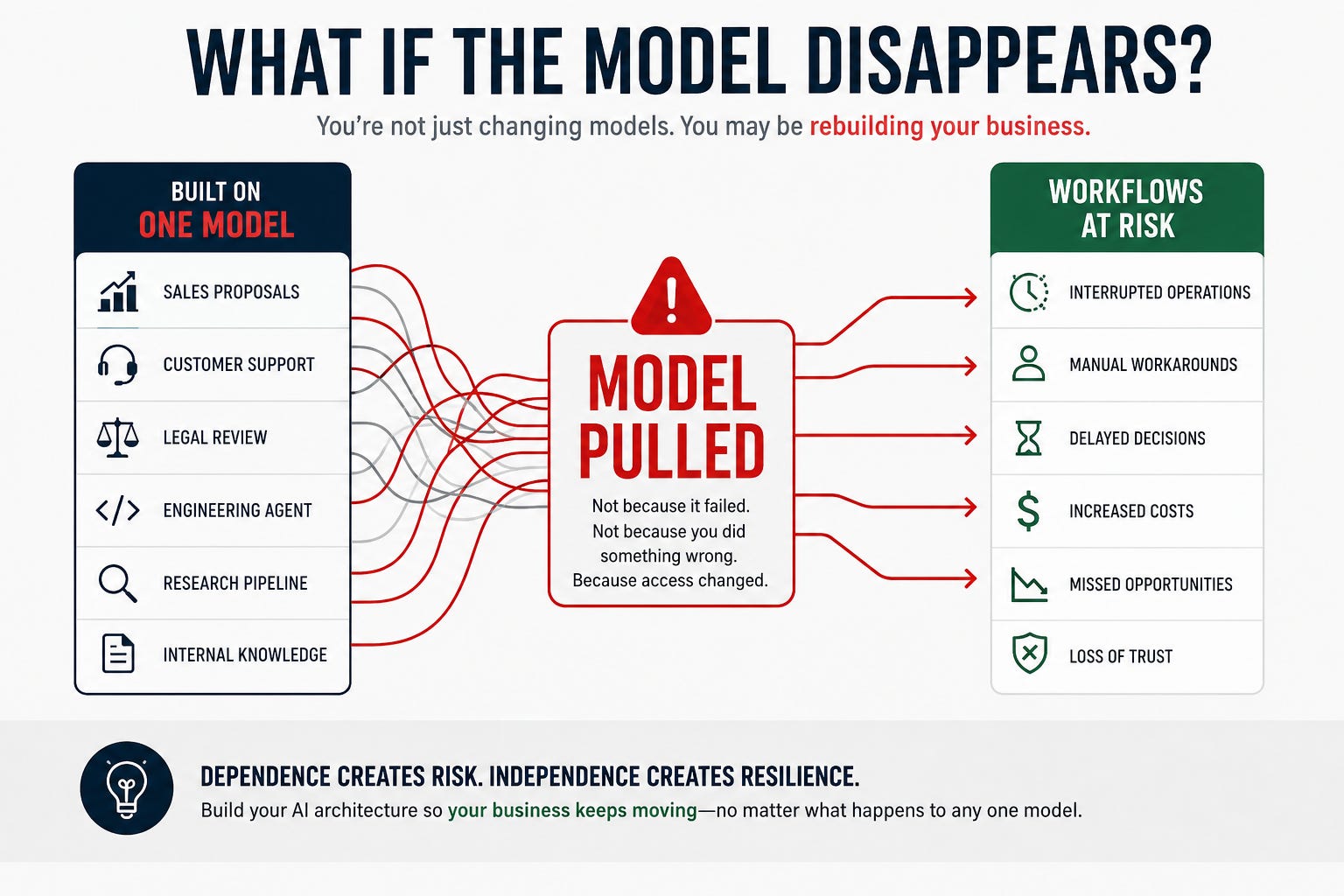
What if your sales proposal process, customer support triage, legal review assistant, engineering agent, research pipeline, or internal knowledge system depended on it?
What if your employees had been trained around it, your prompts had been tuned for it, your review process had adapted to it, your quality expectations had been set by it, and your output standards had quietly assumed it would always be there?
Then one day, the model is pulled.
Not because the model is bad. Not because your company violated policy. Not because you failed to pay the bill. Not because the vendor chose to end your account.
Because the government stepped in and the access path changed.
Now what?
That is the question I think every serious AI leader should be asking.
You are not just changing models
This is the part most AI adoption plans underestimate.
When a model disappears, you are not simply swapping a dropdown option.
You may be rebuilding a workflow.
A different model may not follow the same instructions as reliably. It may not handle long context, tool calls, latency expectations, coding ability, domain language, structured output, multimodal support, compliance posture, or agent behavior the same way.
Even when two models appear similar on a benchmark, they may behave differently inside a business process.
That matters because business workflows are not benchmarks. They are sequences of work, judgment, review, handoffs, policies, approvals, integrations, exceptions, and expectations.
A workflow that depends on one model’s behavior is more fragile than it looks.
The model becomes part of the workflow. The workflow becomes part of the operating model. The operating model becomes part of the business.
That is how dependence happens.
Quietly.
Then suddenly.
This is what dependency looks like
Many companies still think of model dependence as a vendor-lock-in problem.
That is part of it.
But it is no longer the whole problem.
Model dependence is not only what happens when a vendor raises prices, changes terms, deprecates an API, or bundles features into a new plan.
Model dependence is also what happens when a model becomes unavailable because of government pressure, national-security review, export rules, customer eligibility restrictions, geographic limitations, safety classification, or policy enforcement.
A company can do everything right from a vendor management perspective and still find itself exposed if a critical workflow depends on one model that becomes restricted.
The issue is not whether AI companies are trustworthy.
The issue is not whether governments should regulate frontier models.
The issue is whether your business can keep operating when access changes.
That is the operating question.
The problem is not government review
Some people will read these events and make the wrong argument.
They will say the problem is government interference.
Maybe. Maybe not.
That debate matters, but it is not the only lesson for business leaders.
Governments are going to take more interest in frontier AI, not less. These models increasingly touch cybersecurity, critical infrastructure, national security, industrial competitiveness, and public safety.
That means model access will not always be governed only by product-market fit. It may also be governed by policy, export controls, safety reviews, citizenship, residency, industry, customer class, approved-use categories, or relationships your company does not control.
That is the new operating reality.
A serious AI strategy has to account for it.
Model access is becoming a business-continuity issue
When companies think about business continuity, they usually think about cloud outages, cyberattacks, vendor failures, data loss, power failures, and supply-chain disruptions.
AI model access now belongs in that conversation.
Once a model supports a real workflow, it becomes part of your operational supply chain. If it can be restricted by a party outside your control, it needs the same continuity thinking you would apply to any critical vendor, system, or infrastructure dependency.
If your team cannot process customer requests without it, your sales cycle slows without it, your engineers lose a core coding workflow without it, or your legal, compliance, or research process depends on it, then it is an operational dependency.
And if a government order, vendor restriction, export rule, or eligibility change can remove that dependency without warning, then your AI strategy needs a continuity plan.
Not someday.
Now.
Model independence is the continuity plan
Model independence is not an abstract preference.
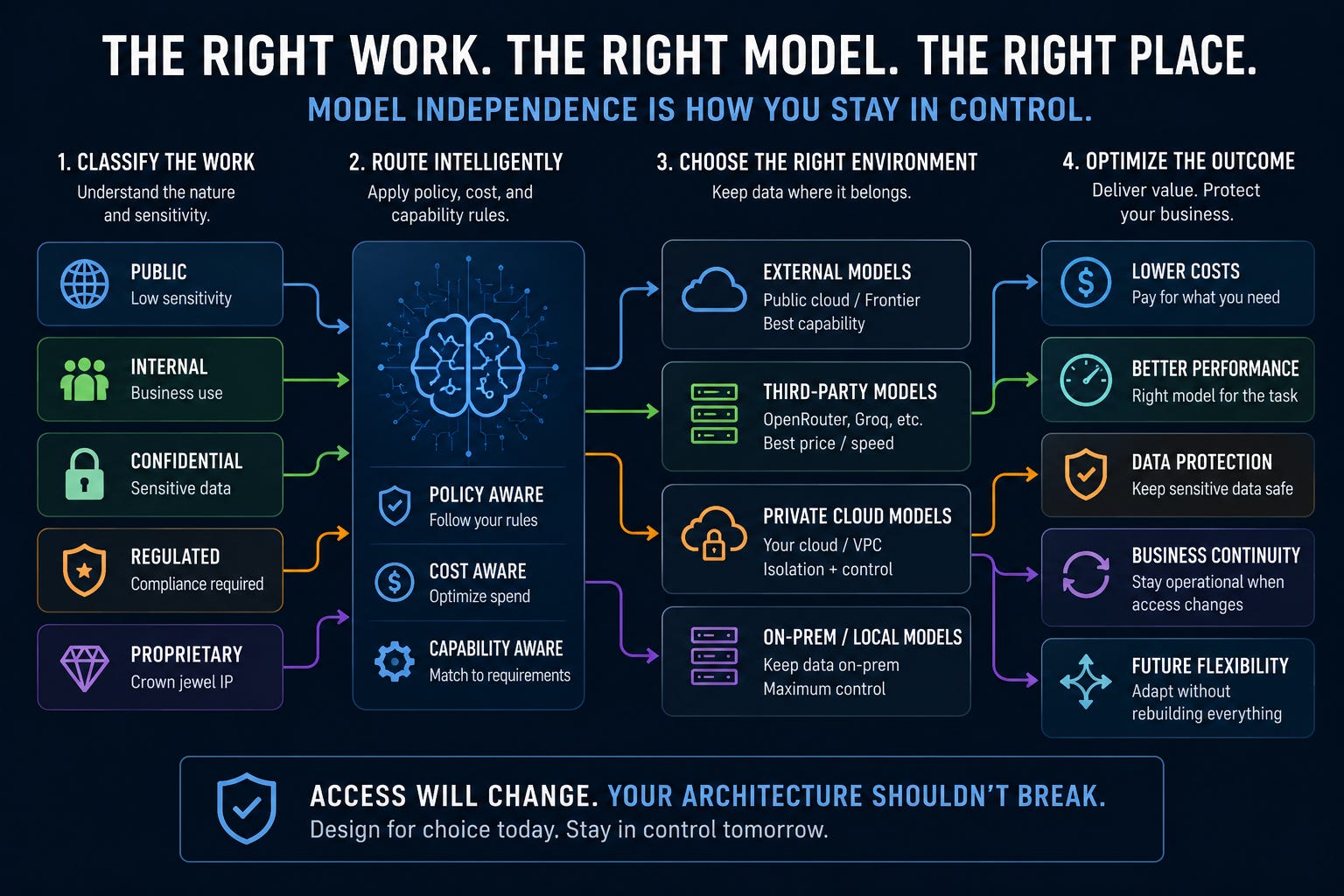
It is the ability to choose, route, govern, replace, and optimize AI models and environments without rebuilding the business workflows that depend on them.
That does not mean every model is interchangeable. They are not.
It does not mean every workflow can instantly fail over with no degradation. That is not realistic.
It does not mean companies should avoid frontier models. That would be foolish. Frontier models are powerful, and some work deserves frontier-level capability.
Model independence means the business is not helpless when access changes.
It means workflows are designed with routing in mind. It means prompts, policies, tools, and integrations are not trapped inside one provider’s interface. It means sensitive data can be redirected to approved environments. It means high-value work can use premium models when appropriate, while lower-risk work can use other options. It means the company has a plan for fallback, substitution, degradation, and recovery.
It means business logic belongs to the business, not the model vendor.
The wrong lesson is “never use frontier models”
I do not believe companies should avoid frontier models.
I believe they should use frontier models deliberately.
Use them where they are justified. Use them where the capability matters. Use them where the business value is high enough to justify the cost, dependency, and data exposure profile.
But do not confuse access with control.
Do not confuse a powerful model with an operating strategy.
Do not confuse today’s availability with tomorrow’s guarantee.
A frontier model can be the right tool and still be the wrong single point of failure.
That distinction matters.
The right question is not “Which model wins?”
The market loves the model race.
Which model is smarter? Which model codes better? Which model reasons longer? Which model wins the benchmark? Which model has the biggest context window?
Those questions matter, but they are not enough for businesses building real AI operations.
The better question is what happens when access changes.
What happens if this model is delayed, restricted, pulled, made available only to approved customers, affected by foreign-national rules, changed by new terms, or altered by vendor or government policy?
Those are not paranoid questions.
They are operating questions.
The future belongs to companies that can reroute
AI adoption is moving from experimentation into operations.
That changes the standard.
Experimental AI can tolerate fragility. Operational AI cannot.
An experiment can break. A business process needs continuity.
An experiment can depend on one vendor. A business process needs options.
An experiment can rely on a manual workaround. A business process needs designed fallback.
This is why routing matters.
Routing is how model independence becomes operational.
A company should be able to route work based on capability, cost, data sensitivity, policy, latency, availability, and business value.
If a model is available, appropriate, approved, and worth the cost, use it. If it is not, route elsewhere. If sensitive data should not leave a boundary, keep it where it belongs. If a task does not require premium reasoning, do not send it to the most expensive model by default. If a model becomes unavailable, degrade gracefully rather than breaking the workflow.
This is not just technical architecture.
It is business resilience.
AI Operating Control is the next layer
The first phase of AI adoption was about access.
Can we use the model? Can we get the tool? Can we test the agent? Can we connect the API?
That phase was necessary.
But the next phase is about control.
Which models are approved? Which work goes where? What data can move? What costs are acceptable? Who can use which capabilities? What happens when access changes? What is the fallback? Who owns the workflow? How do we monitor usage? How do we change course without rebuilding everything?
That is AI Operating Control.
It is the visibility, routing, governance, cost discipline, and data-boundary structure companies need once AI becomes part of real operations.
Model independence is the strategy.
AI Operating Control is the operating model that makes it real.
This is the boardroom issue
The government did not just create an AI policy story.
It exposed a business-risk story.
When a frontier model can be delayed before release, companies should ask what happens when a model is restricted after adoption. When an advanced model can be disabled because of export-control concerns, companies should ask whether their workflows can survive access changes. When model availability depends on approval, eligibility, jurisdiction, policy, safety review, or national-security posture, companies should ask whether their AI architecture has enough flexibility to keep the business moving.
This is no longer only a technical decision.
It is a boardroom decision.
It belongs in AI strategy, vendor risk management, business continuity planning, data governance, and operating model design.
A company that depends on one model for critical workflows is accepting a single point of failure it may not control.
The point
The point is not that OpenAI is bad.
The point is not that Anthropic is bad.
The point is not that government review is always wrong.
The point is that your business should not be fragile because one model, one vendor, one policy regime, one pricing page, or one access decision changes.
If your workflow cannot survive a model delay, you do not have an AI strategy.
You have a dependency.
If your process collapses when a model is pulled, you did not build AI capability.
You rented it.
The companies that win with AI will not simply be the companies with access to the strongest model. They will be the companies that can adapt when access changes.
Preserve choice.
Route intelligently.
Govern data movement.
Build workflows that survive market, vendor, and policy change.
That is model independence.
That is AI Operating Control.
That is what it means to think freely.