


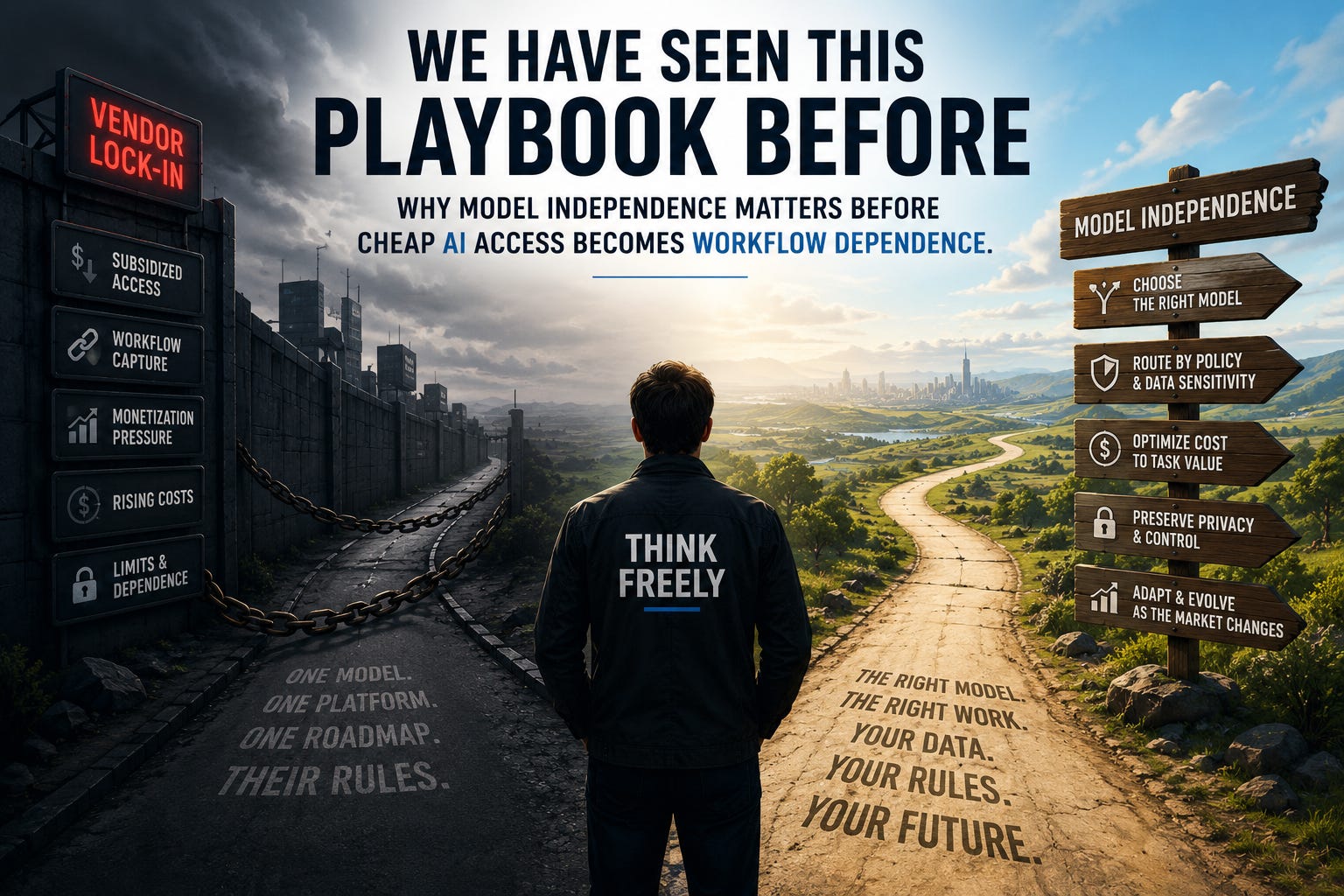
We have seen this playbook before.
A new technology appears. The product feels magical. The price feels impossibly low. In many cases, adoption is subsidized by venture funding, cloud economics, or large companies willing to absorb losses in order to buy market share, shape user behavior, and become the default layer between the customer and the work.
At first, everyone wins.
Users get more capability than they are paying for. Businesses get cheap access to powerful tools. Vendors grow quickly. Investors tell the market that scale will eventually solve the economics.
Then the bill comes due.
The free tier gets smaller. The unlimited plan becomes limited. The cheap plan gets throttled. The feature that used to be included gets moved behind a higher tier. The API pricing changes. The model you built around gets deprecated. The workflow you trusted becomes a product decision made somewhere else.
The subsidy playbook is not complicated:
First, make access cheap.
Second, become the default workflow.
Third, monetize the dependence.
This is not new.
We have seen versions of this pattern in ridesharing, delivery, streaming, and consumer subscription businesses: cheap access first, workflow or habit formation second, monetization pressure later.
AI is entering its own version of that pattern.
The difference is that AI is not just another app category.
AI is becoming a work layer.
That makes the risk bigger.
The subsidy phase always feels like the future
The subsidy phase is seductive because it feels like proof.
When a powerful AI model is available for a low monthly subscription, it is easy to believe that this is the natural price of intelligence. When users can run heavy workloads through a consumer plan, it is easy to believe that unlimited reasoning, coding, research, writing, and automation can be bundled like ordinary software.
But AI does not behave like ordinary software.
Traditional software has high development cost and relatively low marginal cost. Once the product is built, serving another user is often cheap.
AI is different. Every prompt, every output, every reasoning loop, every agentic workflow, every long-context request, every coding task, and every background automation consumes compute.
That does not mean AI is bad economics. It means AI requires operating discipline.
Some AI costs will fall. Some capabilities will become cheaper. Models will get smaller. Inference will get more efficient. Competition will keep pushing the market forward.
That is not the point.
The point is that no business should build critical workflows that only work under one vendor’s current economics.
The danger is that companies are building habits around prices, limits, and availability that may not survive real economics.
That is where companies get hurt.
The problem is not AI vendors
The problem is unmanaged dependence.
Let me be clear: this is not an argument against OpenAI, Anthropic, Google, Meta, Mistral, open-source models, local models, private cloud models, or frontier models.
The goal is not to pick a villain.
The goal is to understand the structure.
Every model provider has incentives. Every platform has a roadmap. Pricing pages are not permanent. Every usage policy can change. Features can be bundled, restricted, removed, copied, renamed, rate-limited, or priced differently.
That is normal business.
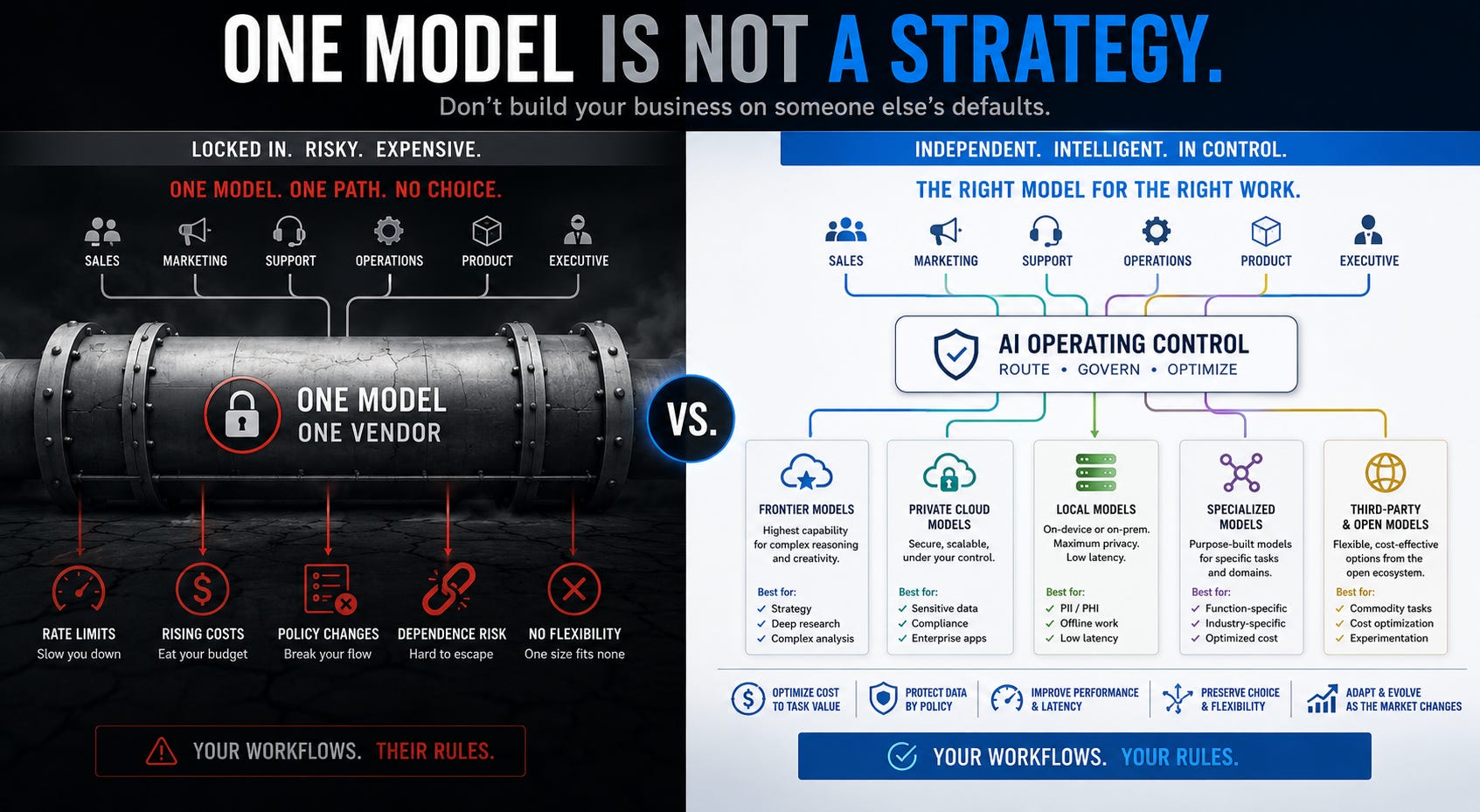
The problem begins when your business workflow becomes dependent on someone else’s default: one vendor, one model, one interface, one pricing structure, one data exposure assumption, one workflow pattern, one set of limits, and one roadmap you do not control.
That is not an AI strategy.
That is vendor dependence wearing the costume of innovation.
What model independence means
Model independence is the ability to choose, route, govern, replace, and optimize AI models and environments without rebuilding the business workflows that depend on them.
It does not mean avoiding major AI vendors. It does not mean rejecting frontier models. It does not mean pretending open source solves every problem. It does not mean local AI is always better.
It means refusing to let any one vendor become the permanent operating center of your AI strategy.
A model-independent company can use frontier models where frontier capability is justified. It can use smaller models where smaller models are sufficient. It can use local or private environments where sensitive data requires tighter control. It can use open-source models where flexibility matters. It can use specialized models where the task calls for specialization.
The point is not to use every model.
The point is to preserve the ability to choose.
That ability matters because the AI market is not settled. It is not even close to settled.
Models will keep changing. Prices will keep changing. Context windows will keep changing. Capabilities will leapfrog. Vendor policies will evolve. Enterprise terms will shift. Features will move between plans. Some providers will win in one category and lose in another.
A company that hardwires its workflows to one model provider is making a bet that today’s winner, today’s price, today’s policy, and today’s feature set will remain the right answer.
That is a dangerous bet.
Model independence is the refusal to make that bet unnecessarily.
What we believe
We believe AI should serve the business, and the business should not become captive to the AI vendor.
We believe the right model depends on the work. Some work deserves frontier-level reasoning. Some work does not.
We believe cost control does not mean using the cheapest model. It means matching model spend to task value.
We believe sensitive data should be routed by policy, not habit. Companies should decide where information can go before it reaches an AI model.
We believe AI workflows should be portable enough to survive market change. A business process should not have to be rebuilt every time a vendor changes pricing, policies, features, models, or limits.
We believe AI adoption needs visibility, direction, and control. Not more tool sprawl. Not more shadow AI. Not more unmanaged dependence.
The old playbook has three stages
The first stage is subsidized access.
The product is underpriced because the real objective is adoption. The company wants usage, habit formation, market share, developer mindshare, enterprise penetration, and default status.
The second stage is workflow capture.
Users stop thinking of the tool as optional. Teams build habits around it. Developers build integrations. Companies create processes that assume the tool will always behave the same way. Executives begin to treat the vendor’s interface as the operating environment.
The third stage is monetization pressure.
Limits tighten. Prices rise. Plans change. Enterprise contracts become necessary. Premium usage gets metered. Heavy users become expensive. Features move. The subsidy narrows. The vendor needs the economics to work.
At that point, the customer discovers whether they adopted a tool or surrendered a workflow.
That distinction matters.
A tool can be replaced.
A captured workflow is much harder to unwind.
AI lock-in happens one workflow at a time
Most companies will not wake up one day and announce that they are locked into a single AI vendor.
It will happen quietly.
A marketing team builds its content process inside one model’s interface. A sales team builds proposal workflows around one assistant. A development team builds coding habits around one agent. An operations team builds reporting shortcuts around one tool. A support team builds knowledge retrieval around one vendor’s ecosystem. A leadership team assumes that because everyone is using the same tool, the company has an AI strategy.
It does not.
It has AI usage.
Those are not the same thing.
AI usage is access.
AI strategy is control.
Imagine a company that builds its proposal process around one AI assistant. The prompts, examples, review habits, and team training all live there.
Six months later, the vendor changes limits, pricing, or model behavior.
The company is not just changing tools.
It is rebuilding a workflow.
The question is not whether people are using AI. The question is whether the company can see it, govern it, route it, measure it, secure it, optimize it, and adapt it when the market changes.
Cheap AI can become expensive
The most dangerous AI cost is not always the obvious invoice.
It is the invisible architecture decision that turns every task into a premium-model task.
A premium model may be exactly right for complex reasoning, sensitive analysis, high-value decision support, advanced coding, or work where quality has material business consequences.
But a premium model should not become the default path for every low-risk, repeatable, low-complexity task.
That is not intelligence.
That is unmanaged spending.
Cost control does not mean using the cheapest model.
It means matching model spend to task value.
Some work deserves the best model available. Some work needs a private environment. Some work needs speed. Some work needs low cost. Some work needs consistency. Some work needs human review. Some work should not touch an external model at all.
The business needs a way to know the difference before usage scales.
Without that discipline, today’s cheap access becomes tomorrow’s budget surprise.
Data independence matters too
Model independence is not only about cost.
It is also about data boundaries.
Different work carries different sensitivity. Public marketing copy is not the same as legal strategy. A generic brainstorming task is not the same as customer data analysis. A support article is not the same as employee records. A public research question is not the same as proprietary operating knowledge.
Companies need to decide where information can go before the information reaches an AI model.
That is data boundary control.
Some tasks may be fine for external frontier models. Some should run through approved enterprise environments. Some should stay in private cloud. Some should stay local. Some should require human approval before dispatch. Some should not be automated at all.
This is not fearmongering.
It is operating discipline.
Sensitive work should go where it belongs.
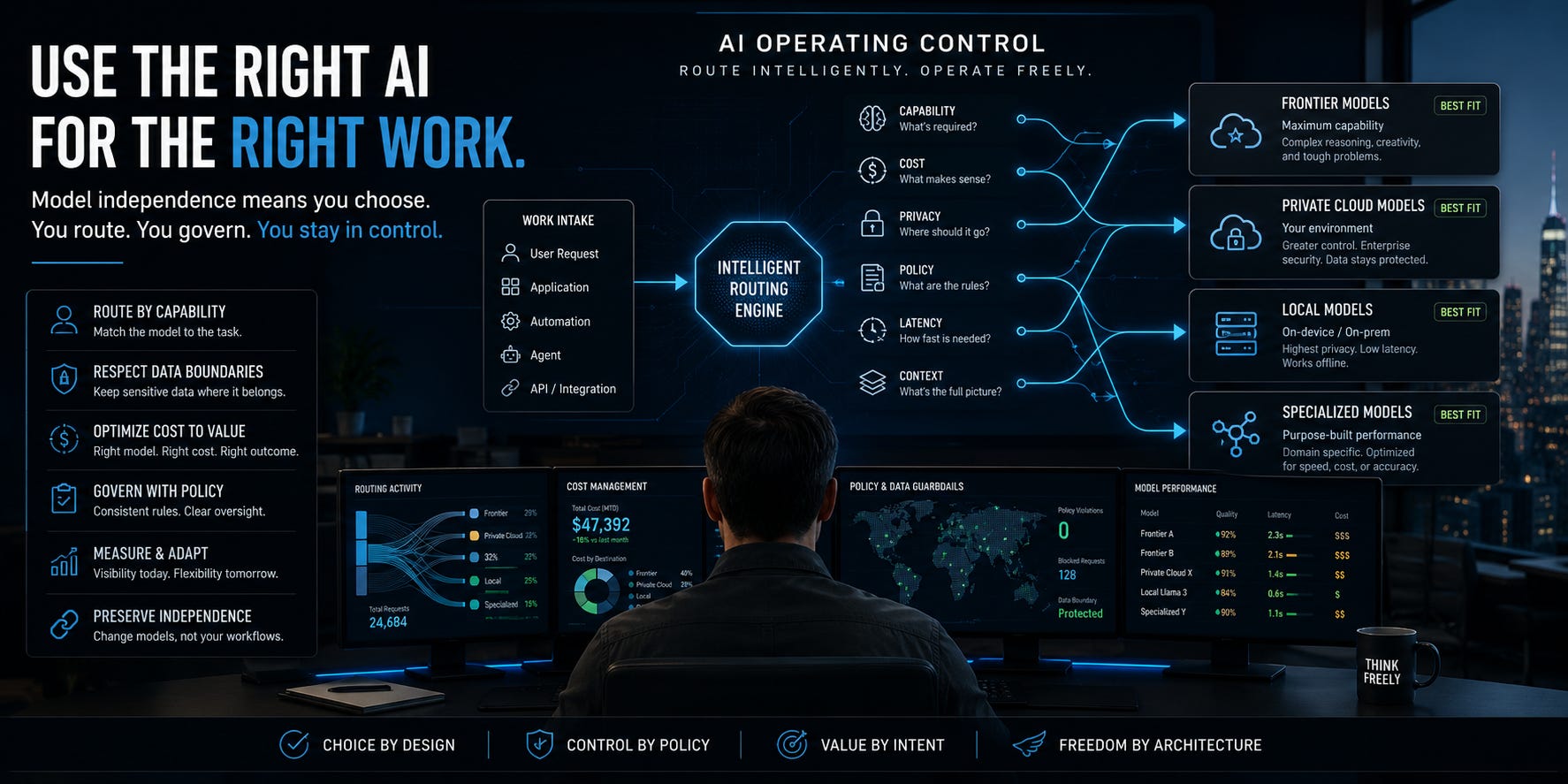
The future of AI is routed
The future is not one model for everything
The future is routed.
Work will be routed by capability, cost, privacy, latency, context needs, compliance constraints, workflow importance, and business value.
Simple tasks should not always consume premium reasoning. Sensitive tasks should not casually leave approved boundaries. High-value work should not be forced through weak models just to save money. Repetitive work should be optimized. Critical work should be governed. Experimental work should be visible.
This is the shift from AI access to AI Operating Control.
Access asks: Can we use AI?
Operating control asks: Which AI should we use, for which work, at what cost, with what data, under what policy, with what human oversight, with what fallback, with what measurement, and with what ability to change later?
Model independence is the strategy.
AI Operating Control is the operating model that makes it real.
Model independence is business independence
The companies that win with AI will not simply be the companies using the most powerful model.
They will be the companies that know how to use the appropriate model for the work.
They will preserve choice.
They will control cost.
They will protect sensitive data.
They will govern usage.
They will avoid hardwiring their business processes to one vendor’s roadmap.
They will build workflows that can adapt as models, prices, policies, and capabilities change.
That is model independence.
Not as a slogan.
As an operating principle.
What it means to think freely
Think freely means your AI strategy should not be captive to one model.
Think freely means your workflows should not be trapped inside one vendor’s interface.
Think freely means premium models should be reserved for work that justifies premium cost.
Think freely means sensitive data should be governed before it moves.
Think freely means AI adoption should create business capability, not hidden dependence.
Think freely means leaders should know what AI is being used, where work is going, what it costs, what data is exposed, and how the organization can change course.
The AI market will keep shifting.
The winners will change. The pricing will change. The policies will change. The capabilities will change. The interfaces will change.
Your business should be able to change with it.
That is why model independence matters.
That is why routing matters.
That is why AI Operating Control matters.
The next phase of AI will not be won by companies that simply adopt faster.
It will be won by companies that adopt with control.
Use the right AI for the right work.
Preserve choice.
Protect the business.
Think freely.