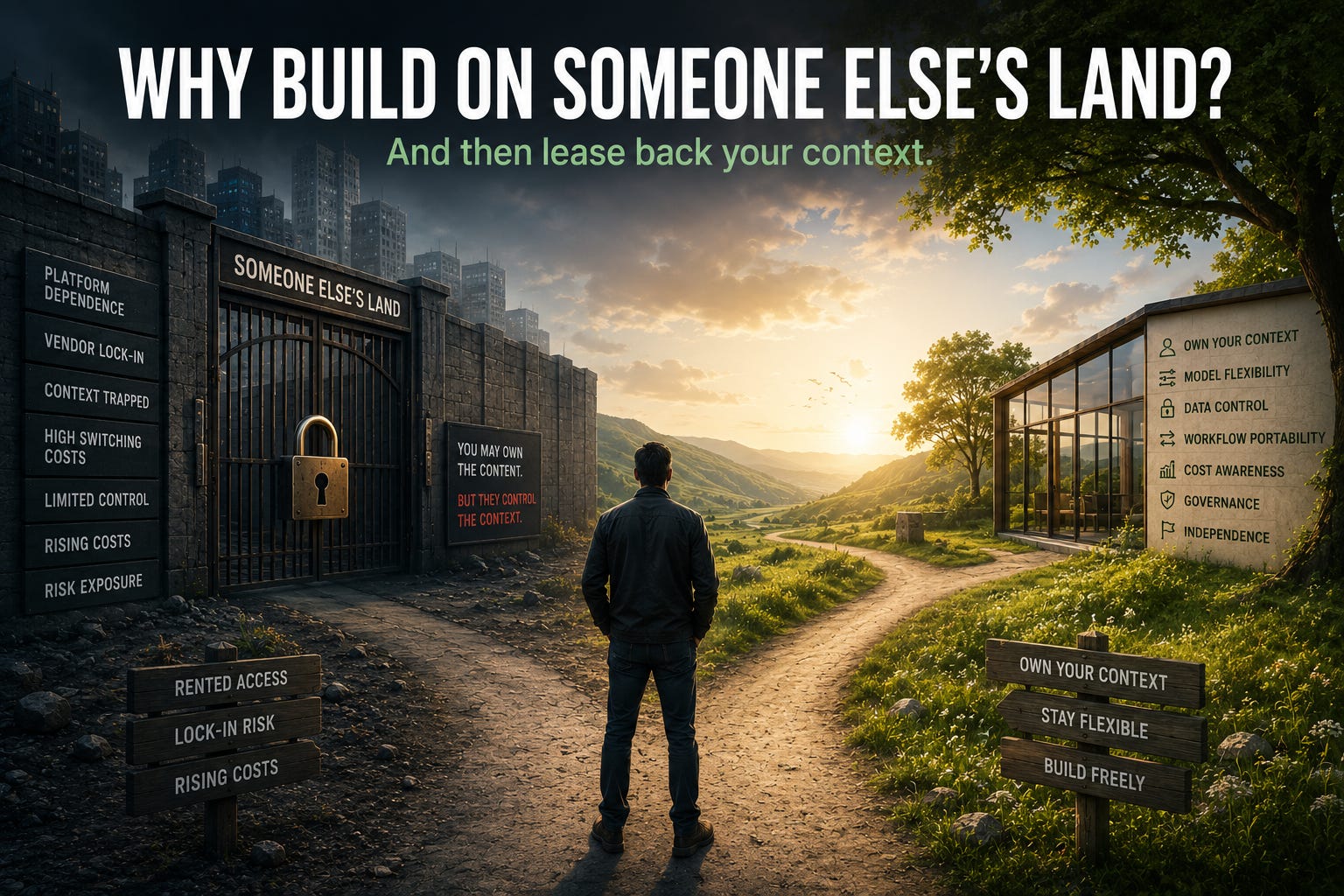
There is an old business lesson that keeps coming back in new forms:
Do not build your future on land you do not control.
It is obvious in real estate. Nobody wants to build a factory, store, or headquarters on property where the landlord can change the terms, raise the rent, restrict access, or decide what happens next.
But in AI, companies are drifting toward a similar problem.
Not because they no longer own their documents.
Not because every vendor is stealing their data.
Not because using AI platforms is inherently wrong.
The issue is more subtle.
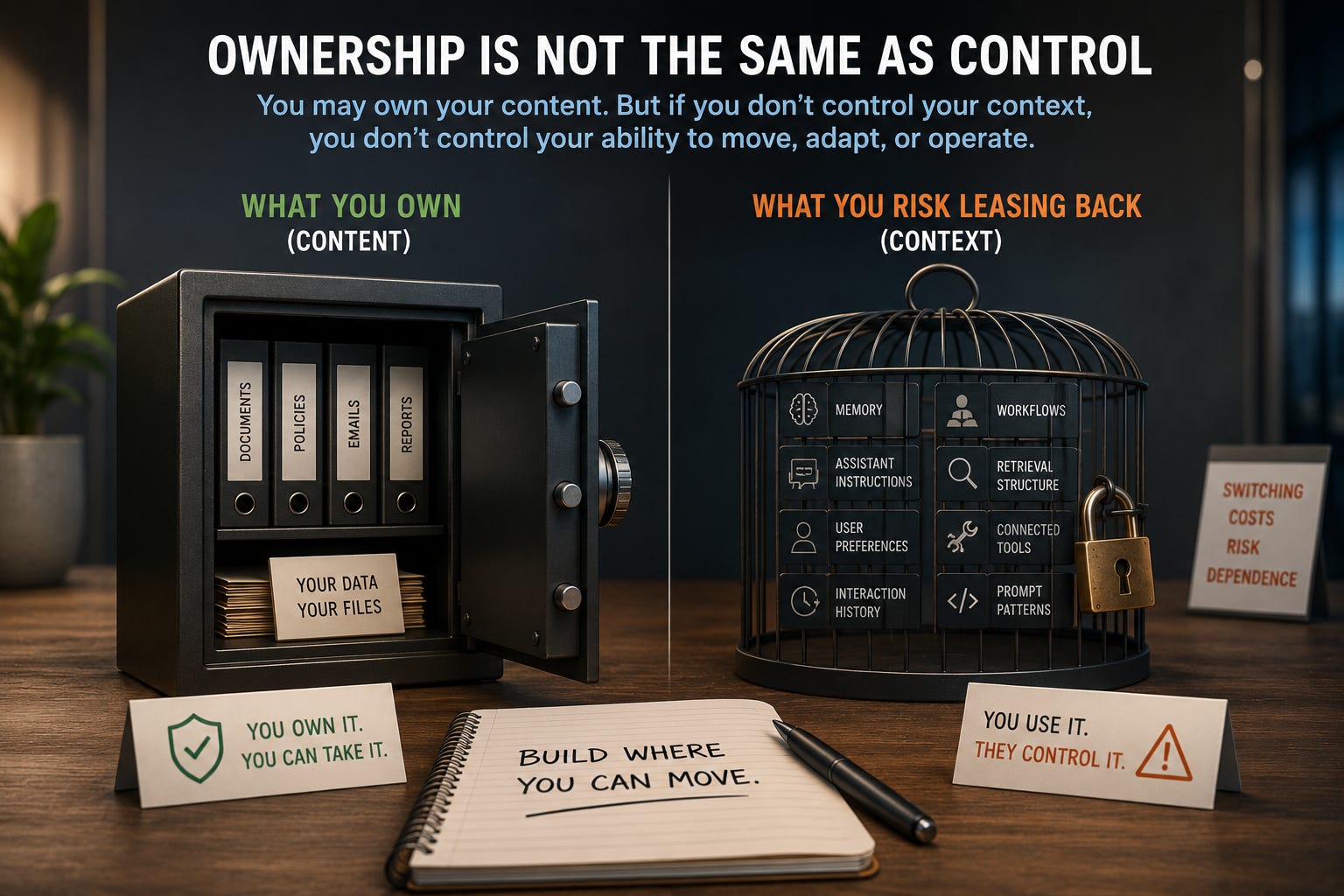
Your content may still belong to you. Your files, emails, policies, notes, transcripts, customer records, knowledge bases, and source materials may remain yours.
But the AI-ready context that forms around that content can become trapped somewhere else.
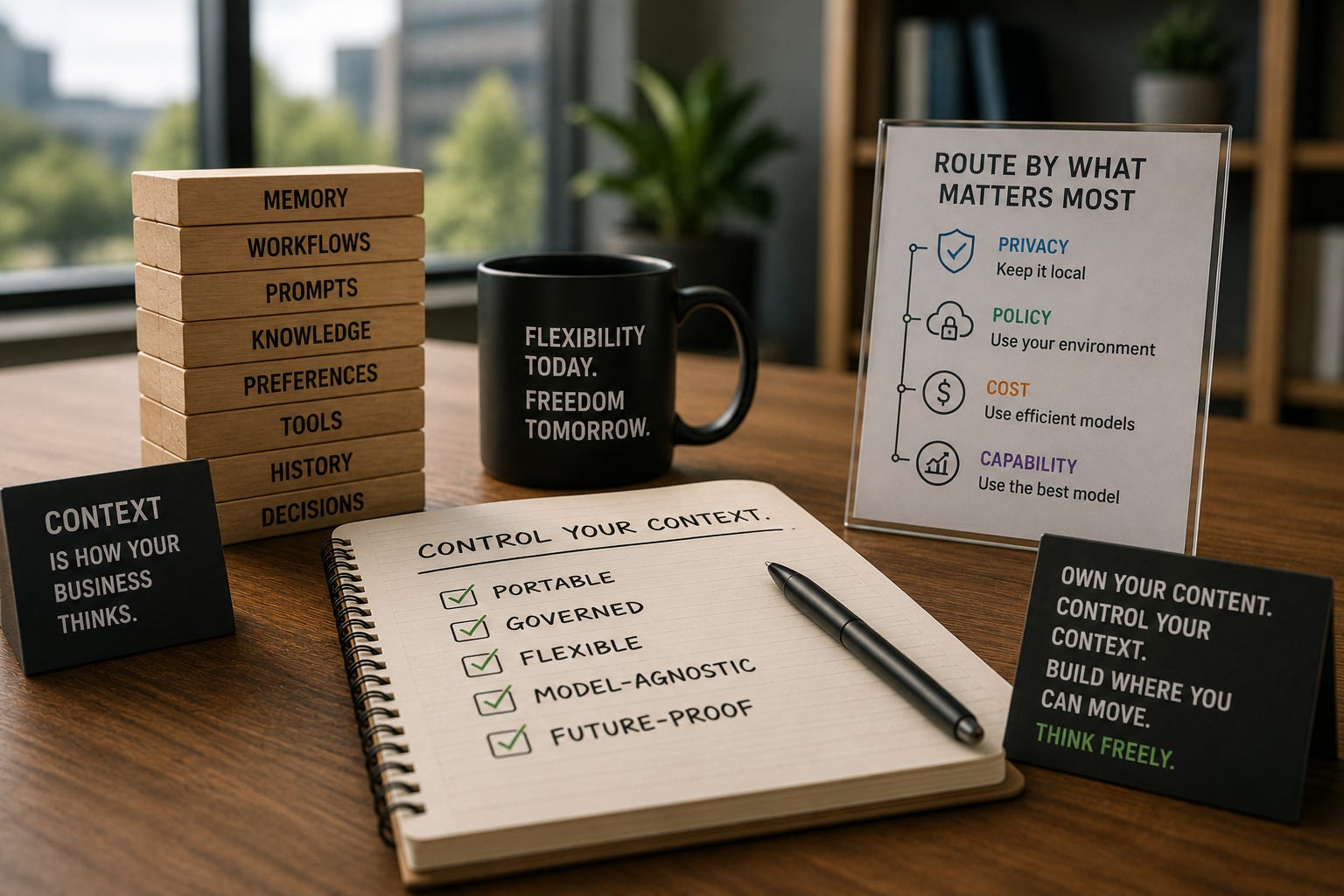
That context includes memory, embeddings, retrieval structure, assistant instructions, workflow behavior, prompt patterns, user preferences, connected tools, and accumulated interaction history. It is the context layer that makes AI useful inside your business.
That is the context companies risk leasing back.
Not the raw documents.
The operational intelligence built around them.
That is not an AI operating strategy.
That is digital tenancy.
And the more valuable your operating context becomes, the more expensive and restrictive that tenancy can get.
Context lock-in becomes switching cost
Context portability is going to become one of the most important questions in AI strategy.
Context lock-in becomes switching cost.
Once your workflows, preferences, memory, retrieval behavior, assistant instructions, and usage habits live inside one platform, leaving is no longer just a procurement decision.
It becomes operational surgery.
You are not only switching software. You are trying to reconstruct how the system learned to work with you.
That is a much harder problem.
A company may own the original documents and still lack control over the AI-ready layer that makes those documents operational.
That is why confusing content ownership with context control is dangerous.
You may own your data and still not control the AI context that makes your data useful.
Context is the new business asset
For years, companies were told that data was the new oil.
That was partly true, but incomplete.
Raw data is not enough. Most businesses already have more data than they know what to do with. The value is in the context around the data.
Context is how your company thinks.
It is your workflows, decisions, customer history, approval patterns, internal language, pricing logic, operational preferences, compliance constraints, role knowledge, process exceptions, sales objections, brand voice, and institutional memory.
Context is what turns AI from a generic chatbot into something useful.
A model can summarize text. Context tells it what matters.
A model can draft an email. Context tells it how your company should sound.
A model can answer a question. Context tells it which source of truth should govern the answer.
A model can automate a workflow. Context tells it what should happen, who should approve it, what risk exists, and what should never be exposed.
That is why business context, AI memory, and workflow knowledge are becoming some of the most important assets in AI adoption.
The trap is not using AI vendors
I want to be clear.
The problem is not using OpenAI, Anthropic, Google, Microsoft, Meta, Mistral, Perplexity, or any other AI provider.
Frontier models are useful. Platform tools are useful. Hosted infrastructure is useful. Some tasks absolutely justify using the best available model.
The problem is not vendor usage.
The problem is unmanaged dependence.
AI vendor lock-in does not happen only when a company signs a bad contract. It happens when a company’s workflows, memories, prompts, retrieval structures, and assistant behavior become inseparable from one vendor-controlled AI platform.
The problem is when a company starts treating one vendor’s interface, one model’s memory, one platform’s connectors, one pricing page, or one proprietary workflow as the foundation of its AI operating model.
That is where the trap begins.
Once your team gets used to working inside one platform, once your prompts are tuned around one model, once your workflows depend on one tool’s feature set, once your retrieval structure lives inside one vendor’s environment, and once your business context becomes inseparable from that system, you no longer have a clean AI strategy.
You have a landlord.
And landlords eventually discover pricing power.
First you bring the content. Then the platform builds the context.
Think about what is happening.
Your team uploads documents.
Your team connects accounts.
Your team trains prompts.
Your team builds workflows.
Your team creates memories.
Your team adds company knowledge.
Your team links tools and systems.
Your team adapts its behavior around the platform.
Over time, the platform becomes more useful because more of your operating context lives inside it.
That does not necessarily mean the vendor owns your content.
But it may mean the practical value of your AI system now depends on context structures you do not fully control, cannot easily export, cannot easily inspect, or cannot easily recreate somewhere else.
You may own the documents.
But do you own the memory layer?
Do you own the retrieval behavior?
Do you own the workflow logic?
Do you own the prompt patterns?
Do you own the assistant configuration?
Do you own the accumulated interaction history in a usable, portable form?
Can you export AI conversations in a way that preserves working context?
Can you export AI memory in a way that another model or interface can actually use?
If the answer is no, then you are not simply paying for software.
You are paying for access to the operating context your business trained into the platform.
That may be acceptable when done intentionally. It may even be the right tradeoff in some cases.
But it should never happen by accident.
Right now, a lot of AI adoption is happening by accident.
A department signs up for a tool. Another team starts using a different model. Someone connects a knowledge base. Someone else builds automations. Leadership sees productivity gains but does not fully see where the context is going, what workflows are becoming dependent, what data is exposed, what costs are scaling, or how difficult it would be to move later.
That is how companies wake up one day and realize they are not just using a platform.
They are living on it.
Large institutions are making the point easier to see
Large institutions are racing to adopt AI. The pressure is obvious. Nobody wants to be left behind.
But the larger the institution, the more important the operating questions become:
Who controls the context?
Who controls the workflow?
Who controls the cost structure?
Who controls the routing?
Who controls the data boundary?
Who controls what happens when the vendor changes the rules?
The bigger the institution, the more visible the issue becomes. But the same issue exists for mid-sized businesses, agencies, law firms, healthcare groups, manufacturers, financial companies, and professional service organizations.
AI adoption without control becomes dependence.
And dependence gets expensive.
This has already happened outside AI
This is not an AI-only problem.
The technology changes, but the lesson stays the same:
Ownership is not the same as control.
In 2024, UniSuper, an Australian pension fund, was knocked offline after a Google Cloud incident affected its private cloud environment. Google Cloud later published an incident review explaining that an internal configuration issue led to the deletion of one of UniSuper’s Google Cloud VMware Engine private clouds. Recovery was possible because UniSuper had a resilient architecture and backups that were not affected by the deletion.
That is the point.
The data may have belonged to UniSuper, but access and recovery depended on the architecture around it.
In 2019, Myspace acknowledged that music, photos, and videos uploaded before 2015 may no longer be available after a server migration project. Pitchfork reported that Myspace’s own “Stats & Facts” page said the site hosted 53 million songs.
Those songs were created by users.
But the archive lived on a platform those users did not control.
Nirvanix gave customers roughly two weeks to move their cloud storage data before shutdown. Wired reported that some larger Nirvanix customers were storing between 10 and 20 petabytes of data, which would be difficult to migrate in that amount of time.
These were not the same kind of failure.
One was a cloud incident.
One was a platform migration failure.
One was a vendor shutdown.
But they all point to the same strategic lesson:
Your data can legally belong to you and still be practically out of your control.
AI makes that problem bigger.
Because with AI, the risk is not only losing files.
It is losing the context, memory, workflow behavior, assistant configuration, and operating intelligence that forms around those files.
Have you noticed there is no simple way to export your context?
A lot of AI platforms are moving toward memory.
That makes sense. Memory makes AI more useful. It reduces repetition. It personalizes responses. It allows systems to become more helpful over time.
But platform memory and business memory are not the same thing.
Platform memory lives inside someone else’s environment.
Business memory should be portable, governed, structured, and controlled by the business.
Have you noticed there is no simple way to export your context?
Not just your files.
Not just a transcript here or there.
Your actual working context.
The conversations. The memory. The preferences. The instructions. The corrections. The workflow history. The patterns that teach the system how your company thinks, communicates, decides, and repeats work.
That is the part most companies are not paying enough attention to.
You may be able to download documents.
You may be able to copy and paste a chat.
You may be able to export certain account data depending on the platform.
But can you take the usable AI context with you?
Can you move the memory layer?
Can you export the assistant behavior?
Can you preserve the workflow history?
Can you take the accumulated conversation context and plug it into another model, another vendor, another interface, or your own private AI environment?
In practical terms, context portability is rarely as simple as exporting a file.
And that is the strategic issue.
If your AI system becomes more useful the longer you use it, but the context that makes it useful cannot move with you, then the platform is not only hosting your AI experience.
It is holding the accumulated operating memory that makes switching painful.
That is how AI platform lock-in forms.
Not all at once.
Not through one dramatic decision.
It happens conversation by conversation, workflow by workflow, memory by memory, until the convenience of staying becomes stronger than the freedom to leave.
A serious AI strategy should not only ask, “Can we use this tool?”
It should ask:
Can we leave without losing what we built here?
The land analogy
Imagine building a restaurant on leased land.
You may own the tables, ovens, recipes, signs, and inventory. But the operating value of the restaurant is tied to a location you do not control.
If the landlord raises the rent, changes the rules, limits your hours, or requires you to use their approved payment processor, the problem is not that leasing was always wrong.
The problem is that you built too much strategic value on land you did not control.
That is where many companies are heading with AI. They are not just renting model access. They are building context, workflows, habits, and operational dependency on someone else’s land.
What AI independence really means
AI independence does not mean avoiding vendors.
It does not mean using only open source.
It does not mean every model has to run locally.
It does not mean frontier models are bad.
It means your business does not become captive to one provider, one model, one interface, one memory system, one workflow pattern, or one pricing structure.
AI independence means you can choose.
You can use a frontier model when the work justifies it.
You can use a lower-cost model when the task is simple.
You can use a private environment when the data is sensitive.
You can use a local model when the use case demands control.
You can switch providers when pricing changes.
You can preserve workflows when models improve.
You can route work based on cost, capability, privacy, and policy.
You can keep your business context portable.
That is the point.
AI independence is not anti-vendor.
It is anti-dependence.
The goal is not to reject AI platforms.
The goal is to avoid becoming owned by them.
The companies that win will control the layer above the models
Models will keep changing.
Prices will change.
Context windows will expand.
Features will be bundled.
Terms will shift.
Vendors will rise, fall, merge, restrict, subsidize, and reprice.
A model that looks unbeatable today may be ordinary tomorrow. A cheap model today may become expensive later. A feature that feels essential may get removed, paywalled, changed, or copied.
So the durable advantage is not simply picking the “best” model.
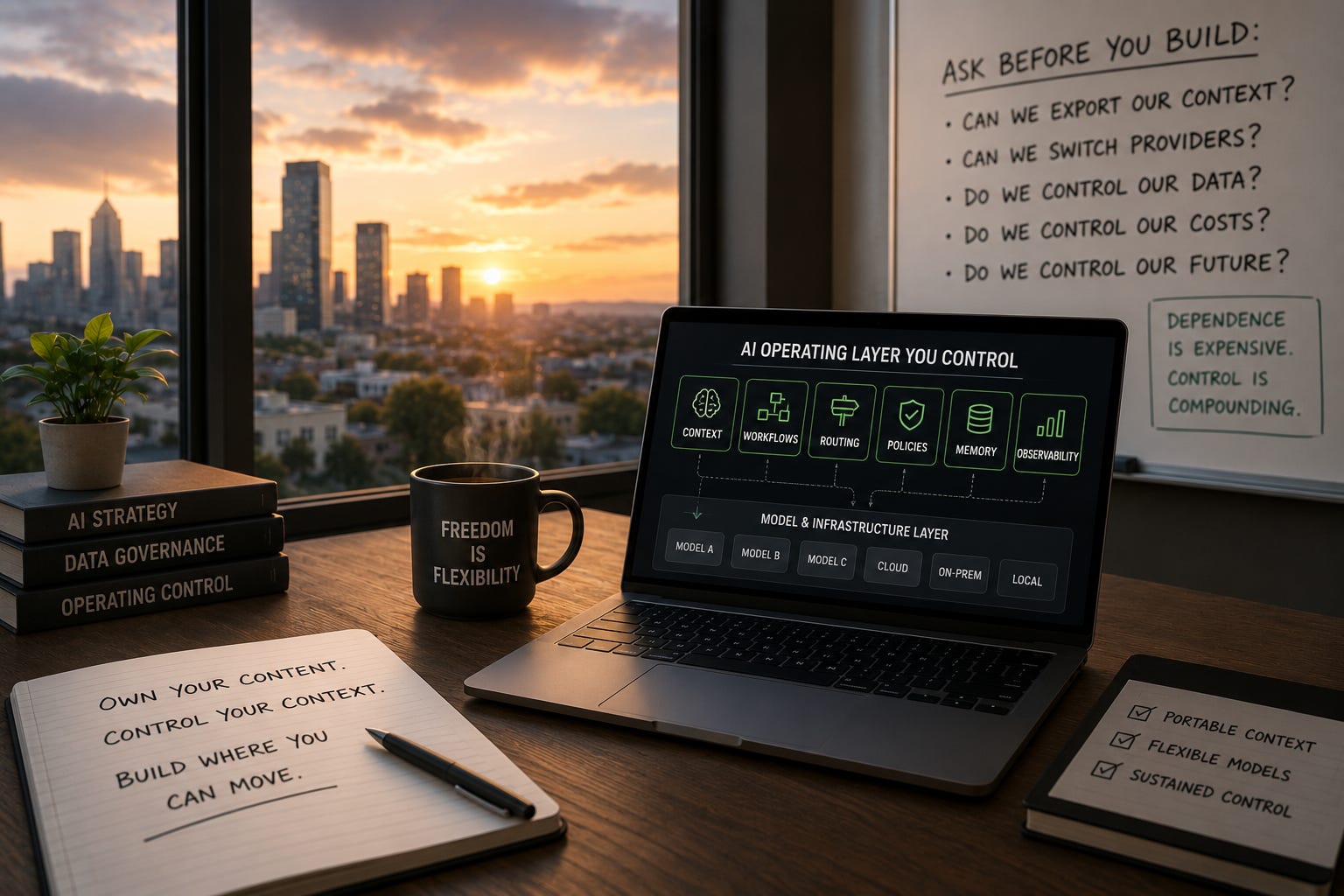
The durable advantage is building an AI operating layer that lets your company adapt.
That means separating your business logic from the model provider.
It means keeping context portable.
It means building AI governance above the vendors.
It means creating routing discipline.
It means knowing which work goes where, what it costs, what data is exposed, and what happens when conditions change.
That is what serious AI strategy will require: model flexibility, portable workflows, data boundary control, cost-aware routing, and governance over the context layer.
The companies that win with AI will not just be the companies using the most powerful models.
They will be the companies that know which models to use, when to use them, what context to provide, what data to protect, what costs to accept, and how to stay flexible.
Build where you can move
The question every leadership team should be asking is simple:
Are we building AI capability we control, or are we building dependency we will have to lease back later?
That question should shape every AI decision.
Before you connect a knowledge base, ask whether the context is portable.
Before you build workflows inside a vendor platform, ask whether they can survive a provider change.
Before you let teams standardize on one model, ask whether every task actually deserves that model.
Before you give a platform memory over your business, ask who owns that memory and how it can be governed.
Before you scale AI adoption, ask whether leadership has visibility, direction, and control.
Because once your context becomes valuable, someone is going to charge for access to it.
The only question is whether you own the layer that makes it usable.
Do not confuse convenience with control
The easiest AI path is usually the most dependent one.
One login.
One vendor.
One model.
One workspace.
One set of defaults.
One memory layer.
One bill.
One roadmap you do not control.
That can feel efficient in the beginning.
But convenience becomes architecture.
Architecture becomes dependency.
Dependency becomes pricing power for somebody else.
AI should not reduce your options.
It should expand them.
So yes, use great models.
Use great tools.
Use great platforms.
But do not build your future on land you cannot control and then act surprised when the rent goes up.
Own your content.
Control your context.
Build where you can move.
Think Freely.