



Reuters recently reported that Meta paused an internal AI training program after concerns that sensitive employee data was accessible too broadly inside the company. The program reportedly collected mouse movements, clicks, and keystrokes from U.S. employees to support AI training.
Cisco’s 2026 Data Privacy Benchmark Study found that AI is now the primary driver of expanded privacy programs for 90% of surveyed companies, with 93% planning further investment to keep up with AI system complexity and rising expectations from customers and regulators.
The lesson business leaders should take seriously is this:
AI privacy is no longer only a legal or compliance issue.
Enterprise AI privacy is becoming an operating-model problem.
Most companies are approaching AI privacy too late.
They warn employees not to paste sensitive information into the wrong tool. They publish acceptable-use policies. They add disclaimers. They tell people to be careful.
That is not enough.
A warning is not an operating model.
If the safety of your AI adoption depends on every employee correctly judging every prompt, every file, every customer detail, every internal document, every legal issue, every trade secret, every spreadsheet, and every workflow in real time, then your privacy strategy is already too fragile.
The user should not have to become a data-boundary architect before asking AI for help.
The system should know where sensitive work belongs.
AI privacy governance means defining what data can go where, which models or environments are approved, who can use them, what should be logged or reviewed, and how sensitive information is routed before it reaches an AI system.
The prompt is too late
By the time an employee is typing a prompt, the privacy decision may already be happening under pressure.
They are trying to finish a proposal. They are trying to answer a customer. They are trying to summarize a document. They are trying to analyze a spreadsheet. They are trying to fix code. They are trying to get work done.
That is the point.
People use AI because it helps them move faster.
But speed creates risk when the system depends on individual judgment alone.
Is this customer data, confidential material, regulated information, internal strategy, proprietary process knowledge, employee information, or legal material? Is it allowed in this model, this tool, this contract, and this workflow?
Those are not questions every employee should have to resolve on the fly.
Some decisions should be designed into the operating model before the prompt is sent.
Users are not the control layer
A mature company would not let every employee decide where customer data is stored.
It would not let every employee decide which payroll system to use.
It would not let every employee choose their own compliance process.
It would not let every employee personally interpret every security policy at the moment of use.
But that is often how AI adoption is happening.
The user picks the tool.
The user picks the model.
The user decides what data to paste.
The user decides whether the work is sensitive.
The user decides whether the output needs review.
The user decides whether the risk is acceptable.
That is too much responsibility at the wrong layer.
Users should be able to focus on the work.
The operating model should handle the routing.
We have already seen the first version of this problem
The early lesson was simple: do not paste sensitive data into public chatbots.
Forbes reported in 2023 that Samsung banned ChatGPT and other AI chatbots for employees after reported concerns about sensitive internal information being leaked through workplace AI use.
That was the first-generation version of the problem.
The new version is broader.
It is not only about whether an employee pastes source code into a public chatbot.
It is about whether the company has a controlled operating model for AI data movement at all.
Which data can go where? Which users can use which models? Which vendors can receive which categories of information? Which workflows require private infrastructure? Which requests should be blocked, redacted, logged, reviewed, or rerouted?
Which decisions should be left to user judgment?
Which decisions should be handled by policy and system design?
That is where the conversation has to go next.
The better question is: what data can go where?
The real question is not simply, “Are we allowed to use AI?”
The better question is:
What data can go where?
That question should shape the entire AI operating model.
Public information may be acceptable for external models. Internal business information may require approved enterprise environments. Confidential customer information may need stricter controls. Regulated information may require private infrastructure, auditability, retention rules, access control, or human review. Proprietary operating knowledge may need protection even when it is not formally regulated.
Different data belongs in different places.
That is data boundary control.
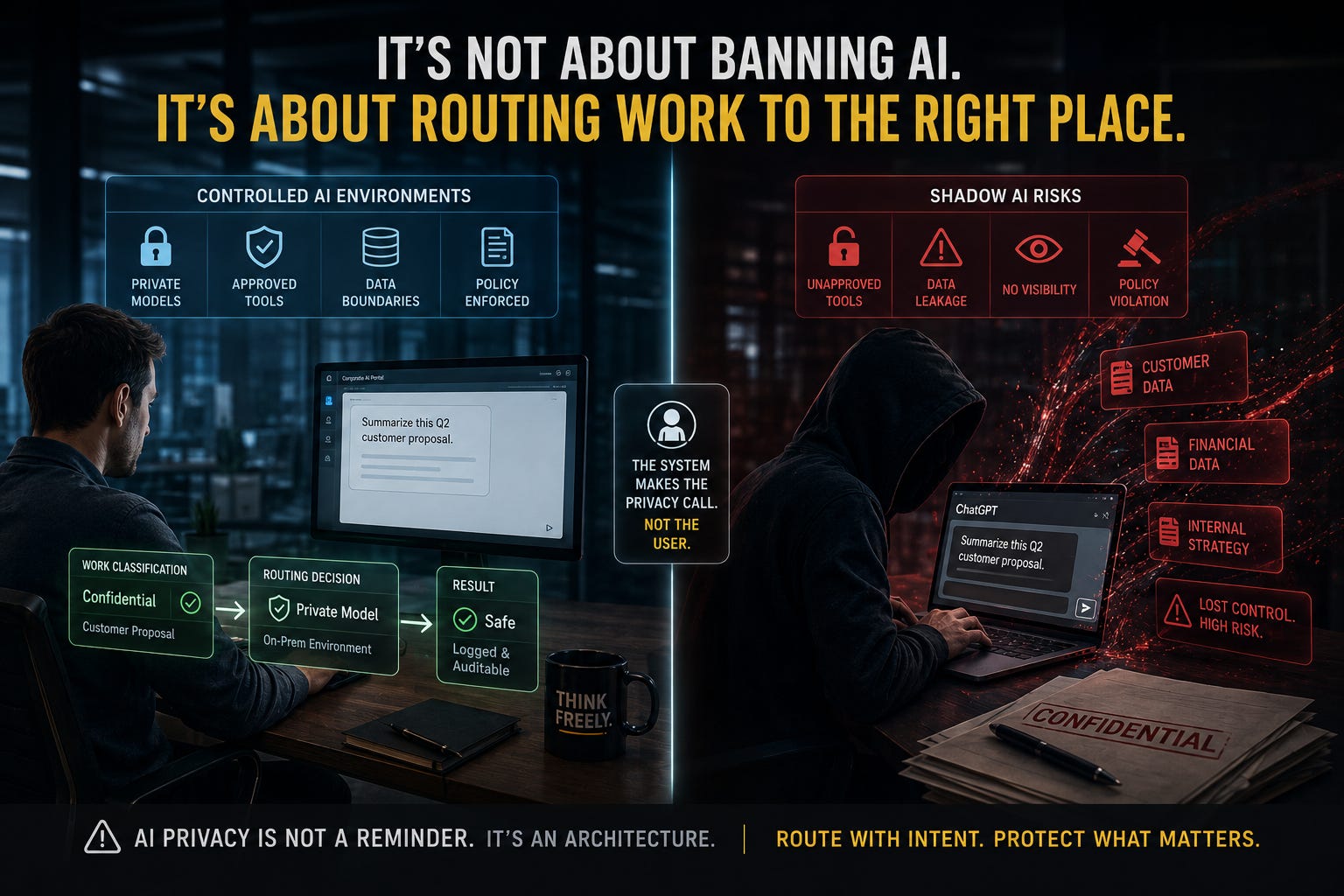
Not all work has the same sensitivity
A public marketing brainstorm is not the same as a customer contract. A blog outline is not the same as an employee performance review. A generic coding question is not the same as a proprietary codebase. A support article is not the same as a customer ticket history. A public research summary is not the same as a legal memo. A process improvement idea is not the same as a spreadsheet full of financial or operational data.
When companies treat all AI usage the same, they create two bad outcomes.
Either they over-restrict everything and slow down useful adoption.
Or they under-restrict everything and let sensitive work drift into environments that were never designed for it.
Both are failures of operating design.
The right answer is not “AI everywhere.”
The right answer is not “AI nowhere.”
The right answer is controlled routing based on the work, the data, the model, the environment, and the risk.
Sensitive work should go where it belongs
AI adoption becomes safer when data boundaries are intentional.
Some work can go to external frontier models. Some should go to approved enterprise tools, private cloud, or local infrastructure. Some should require human review. Some should not be automated.
That is not fearmongering.
That is basic operational discipline.
The goal is not to scare people away from AI.
The goal is to let people use AI with enough structure that adoption can scale without turning into shadow risk.
Sensitive work should go where it belongs.
That principle is simple.
The hard part is making it operational.
Privacy risk is not always obvious
A company may think privacy risk is only about explicit secrets: customer names, source code, financial records, legal memos, employee records, or trade secrets.
Those matter.
But AI privacy risk is not always that obvious.
A 2026 research paper on anonymized conversational AI logs found that 34.5% of user messages contained personal information. The researchers also found that message-level PII removal was insufficient on its own because models could infer attributes such as age, gender, and country from conversation history.
That matters for enterprises because sensitive context can accumulate.
A single prompt may look harmless. A thread may reveal more. A file plus a prompt plus a user role plus a workflow may reveal even more.
Privacy is not only about obvious PII.
It is about context, inference, aggregation, access, retention, and use.
That is why user judgment alone is too weak.
AI privacy governance needs more than policies
Companies need AI policies.
But policies alone do not create control.
A policy can say, “Do not paste confidential data into unapproved tools.”
That is useful.
But what happens next?
How does the employee know whether the information is confidential? How does the system know which model is approved? How does leadership know whether the rule is being followed? How does IT know where the work is going? How does compliance know whether regulated data is being exposed? How does finance know whether sensitive work is being sent to a premium external model when a private environment would be more appropriate?
Policy without routing becomes a document.
Policy with routing becomes an operating control.
That is the difference.
When a user starts a task, the system should be able to ask what kind of work this is, what data is involved, how sensitive it is, which models are approved, which environments are allowed, what policy applies, whether human review is required, whether the task should stay local or private, whether it can go to an external model, and whether it should be blocked, logged, escalated, or rerouted.
That is how privacy becomes operational.
Not by asking every user to memorize the policy.
By designing the policy into the flow of work.
Data boundary control is model independence
Model independence is usually discussed as freedom from one vendor or one model.
That is part of it.
But model independence also means the business can choose where work should happen based on data sensitivity.
I have written before that model independence is not just a model preference. It is the ability to route, govern, replace, and optimize AI environments without rebuilding the workflows that depend on them.
Some work may justify a frontier model.
Some work may require a private model.
Some work may be safe for a third-party provider.
Some work may belong on local infrastructure.
Some work may need to stay inside an approved environment.
If every task goes to one model, the company has no real data boundary control.
It has one default path.
That default path may be convenient, but convenience is not governance.
A model-independent company can route work according to what the task requires and what the data allows.
That is where privacy and model independence meet.
Guardrails belong inside the workflow
Recent enterprise AI research points in the same direction.
A 2026 paper proposing SafeGPT frames enterprise LLM adoption as a security and ethics challenge when employees inadvertently share confidential data or generate policy-violating content. The proposed system combines input-side detection and redaction, output-side moderation, and human-in-the-loop feedback.
That is the right direction.
Not because one research system is the final answer.
But because the architecture is correct.
Privacy control has to exist at the point of use, before sensitive data moves, before the wrong model receives it, before a policy violation becomes a workflow habit, and before leadership discovers the problem after the fact.
That requires routing, redaction, approval paths, logging, policy enforcement, and human review where appropriate.
It requires systems, not reminders.
The risk is not only data leakage
When people hear “AI privacy,” they often think only about leaks.
That matters, but it is not the whole risk.
The broader issue is loss of control over business information.
Where did the data go? Which model processed it? Which vendor received it? Was it retained? Was it logged? Was it used for training? Was it visible to another system? Was the output reviewed? Was sensitive context mixed with low-risk work? Was proprietary knowledge exposed through an unnecessary path? Can the company audit what happened? Can the company change the route next time?
These are operating questions.
They are not solved by telling people to be careful.
They require visibility, routing, governance, and accountability.
Shadow AI is a data-boundary problem
Shadow AI is usually described as a user behavior problem.
Employees use tools the company did not approve.
Teams experiment outside IT.
Sensitive information may move through unmanaged channels.
That is real.
But shadow AI is also a signal.
It means employees want AI capability faster than the company has provided a controlled way to use it.
If leadership only says no, people will find workarounds.
If leadership says yes without structure, risk spreads.
The better answer is to give teams useful AI access with clear data boundaries, approved environments, and routing logic that matches the work.
Governance should not exist to block AI adoption.
Governance should make safe adoption possible.
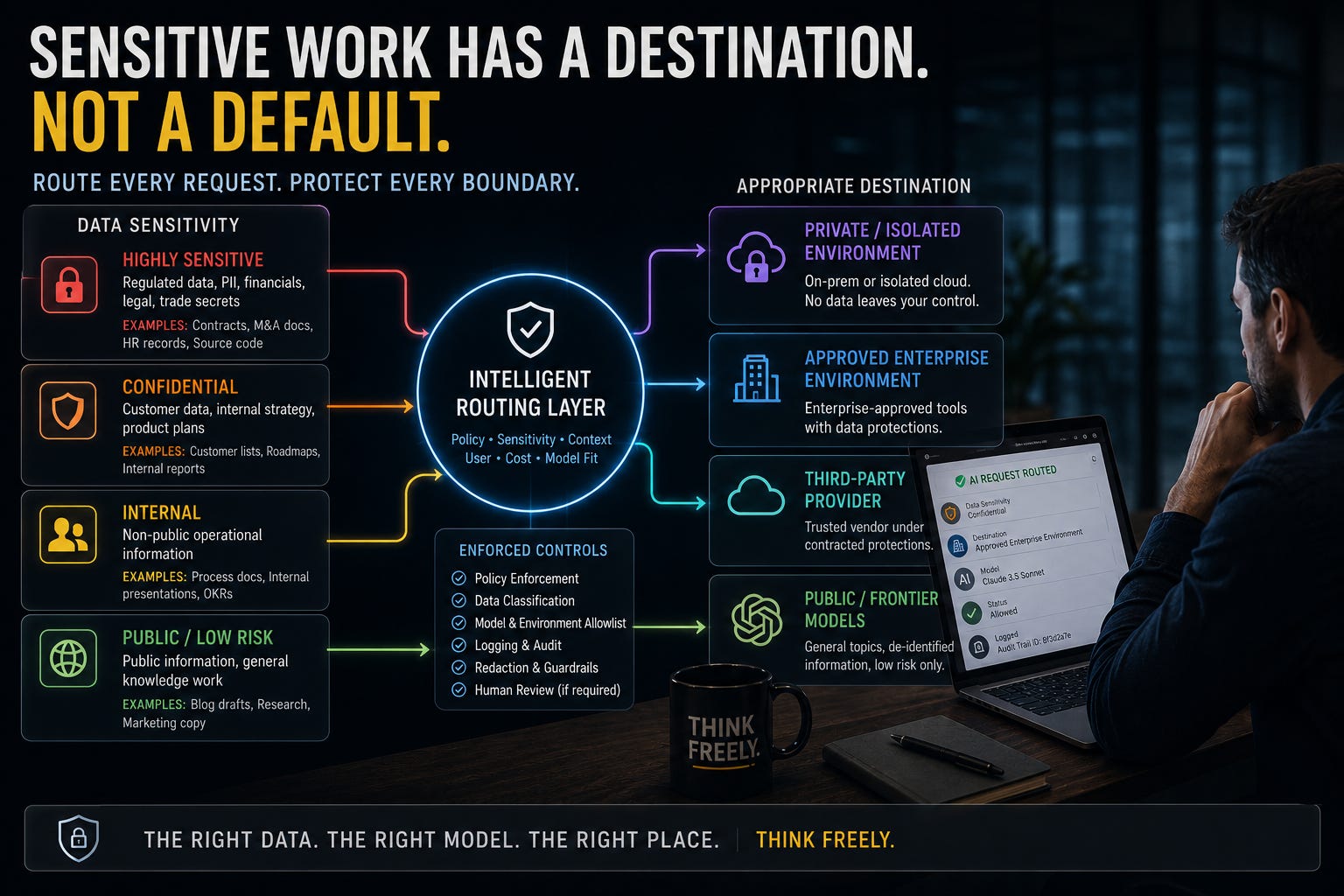
The safest prompt is the one the system knows how to route
Prompt hygiene matters.
Employees should be trained.
People should understand risk.
Teams should know what not to share.
But training is not enough.
Training helps people make better decisions.
Routing reduces how many sensitive decisions they have to make alone.
That matters because AI adoption will only become more embedded: more workflows, more agents, more automations, more integrations, more files, more context, and more data movement.
The more AI spreads, the less realistic it becomes to depend on manual judgment at every point of use.
The safest prompt is not the one an employee remembers to sanitize.
It is the one the system knows how to route.
AI Operating Control starts with knowing where work should go
AI Operating Control is the visibility, routing, governance, cost discipline, and data-boundary structure companies need once AI becomes part of real operations.
For privacy, AI Operating Control means leadership can see what AI is being used, which work is going where, which data types are allowed in which environments, which models are approved, which workflows require review, which requests are logged, and which policies are being enforced.
Without those answers, companies do not have AI privacy control.
They have AI hope.
Hope is not a control layer.
The point
The point is not to make AI scary.
The point is to make AI governable.
The point is not to block employees from using powerful tools.
The point is to give them approved paths that protect the business.
The point is not to trust every prompt to perfect user judgment.
The point is to build systems that know where sensitive work belongs.
AI privacy starts before the prompt is sent.
Data boundaries should be policy, not habit.
Sensitive work should go where it belongs.
Use the right AI for the right work.
Protect the data.
Preserve choice.
Think freely.